Decision note
Corporate advisory services: who owns the market-entry decision?
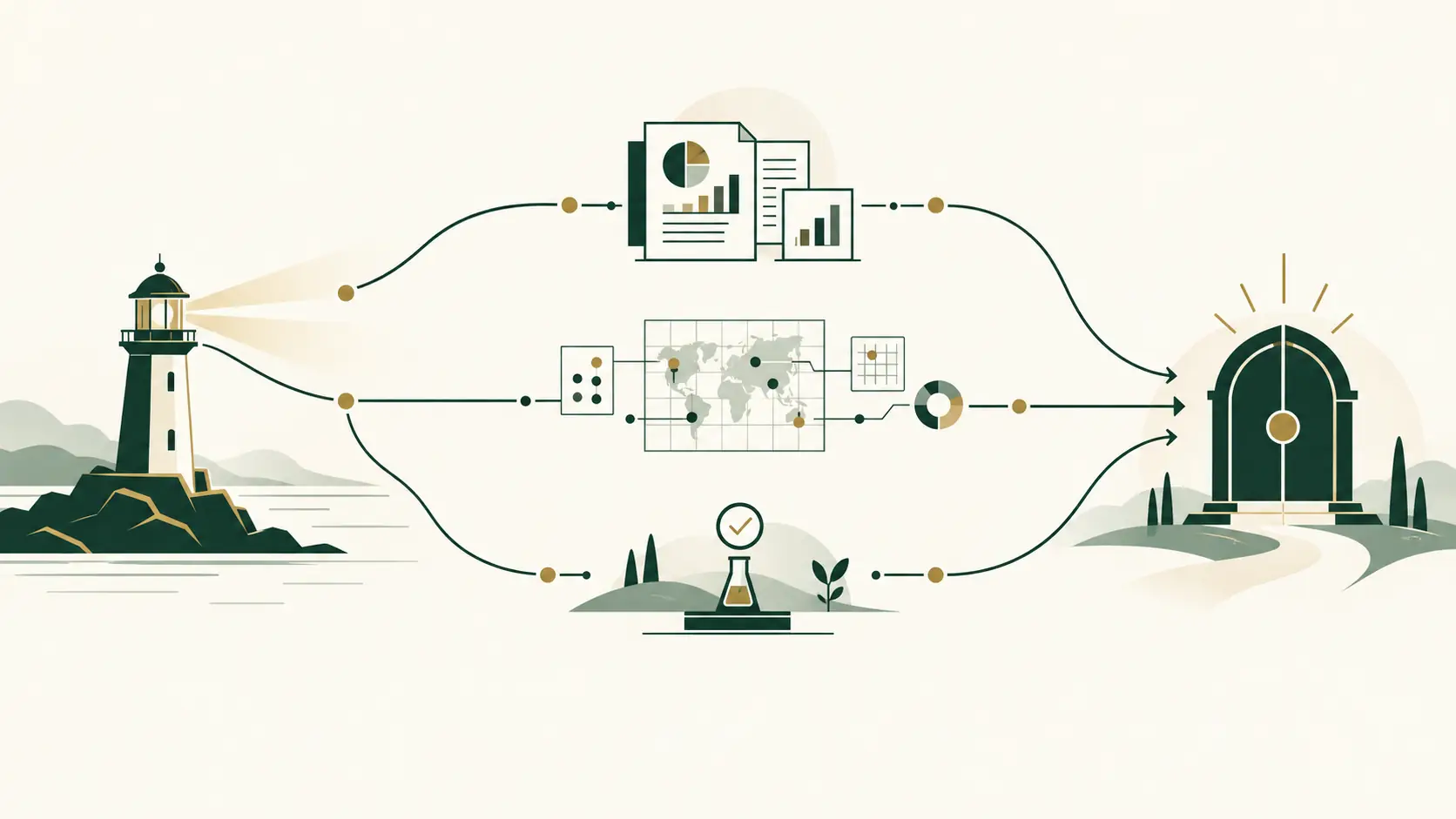
Corporate advisory services can help leaders with company valuation, deal structure, acquisitions, and divestitures. A distant-market entry asks different questions about customers, competitors, routes to market, and operating constraints in one country. Go International Advisory's method assigns valuation and deal work to corporate finance advisors, country-market evidence to market-entry advisors, and the final decision to company leadership. When published research cannot resolve the main demand or access question, Go International Advisory recommends considering a small live market-entry pilot as the next evidence step. The matrix below clarifies those decision rights. It is our editorial framework, not an industry standard.
What do corporate advisory services cover?
The label is broad. Before hiring an advisor, define the decision that the work must support.
PwC, for example, positions its corporate finance and M&A advisory work around acquisitions and divestitures (PwC). That scope is useful when the decision concerns a company, an asset, or a transaction. It does not by itself answer whether buyers in one named country have the problem you plan to solve.
Corporate finance and deal advice may address:
- Company or asset valuation
- Deal structure and financial scenarios
- Acquisition or divestiture analysis
- Transaction preparation and process support
Market-entry evidence may address:
- Which customer segment has the strongest reason to buy
- How local competitors frame the problem
- Which channel can reach qualified buyers
- Which assumptions need direct contact with the market
The two scopes can support the same board decision. They should not be treated as interchangeable.
Why does a distant-market entry need different evidence?
Go International Advisory's method treats a distant market as a new evidence base. It does not assume that familiar customers, channels, buying language, or commercial assumptions will transfer. The method tests the named country instead of repeating a general international growth case.
The U.S. Small Business Administration says market research helps a company identify customers, while competitive analysis helps it differentiate its business (U.S. Small Business Administration). It also distinguishes existing sources, which can save time but may lack audience specificity, from direct research, which can give a more nuanced view of a target audience but takes more time and money (U.S. Small Business Administration).
The SBA source does not address Go International Advisory's offer, channels, buyer engagement, or pilots. Separately, our method uses desk evidence to describe the market and direct evidence to test whether a defined buyer engages with a defined offer through a proposed route to market.
For one named country, the evidence brief should state:
- The target customer and business problem
- The offer and the assumption behind it
- The likely route to the customer
- The evidence that would support, change, or stop the entry case
Who owns each part of the decision?
Use the following matrix to prevent gaps and duplicate work. It is Go International Advisory's editorial framework. It does not represent a formal industry standard.
| Decision or question | Leadership | Corporate finance or deal advisor | Market-entry advisor | Required output |
|---|---|---|---|---|
| What business outcome justifies the move? | Owns and approves | Advises on financial fit | Advises on country fit | A written decision statement |
| What is the company or asset worth? | Sets decision criteria | Owns the analysis | Supplies relevant market context | A valuation case with stated assumptions |
| How should a possible deal be structured? | Approves the boundaries | Owns the analysis | Flags country-market implications | A set of deal options and assumptions |
| Which country customer has a pressing problem? | Confirms strategic fit | Consulted | Owns the evidence | A defined segment and problem statement |
| Can the team reach and engage that customer? | Sets the evidence threshold | Informed | Owns the test | Channel evidence and recorded buyer responses |
| What must be true before resources are committed? | Owns the criteria and final decision | Supplies transaction conditions | Supplies market-entry conditions | A single decision log with open assumptions |
| Is a live pilot needed? | Approves scope and limits | Consulted when a deal depends on the result | Recommends and runs the pilot | A pilot brief tied to one decision |
The boundary is simple. The deal advisor answers deal questions. The market-entry advisor answers country-market questions. Leadership decides how much evidence is enough and accepts the business risk.
When is desk research enough?
Desk research is enough when it can resolve the decision without live market contact. This is usually an early screening stage, not proof of demand.
Use desk research to:
- Exclude markets that fail a stated strategic condition
- Compare visible competitor positions
- Map possible customer segments and channels
- Identify assumptions for direct testing
- Prepare focused questions for buyers or partners
A market intelligence report can organize this evidence. It should end with a decision, an unresolved assumption, or both. A long document without a decision threshold adds reading, not confidence.
When is a live market-entry pilot the next step?
Go International Advisory recommends considering a live pilot when existing sources cannot settle a material assumption. Under our method, the pilot tests one decision and does not imitate a full launch.
Consider a pilot when:
- The team has named one country and one customer segment
- The offer can be presented without building a local operation first
- Buyer access is uncertain
- Desk research leaves conflicting signals about demand or channel fit
- Leadership has defined what evidence would support, change, or stop the plan
Do not start with a vague goal such as "test the market." Write the disputed assumption. Name the people whose response matters. Set the evidence threshold before outreach begins.
If direct market contact is now the missing piece, Go International Advisory recommends a market-entry pilot to test the assumption with a controlled scope.
How should you brief both advisors?
Give both advisors the same decision statement. Separate their work packages, then require them to record linked assumptions in one place.
Your brief should include:
- One named country
- One entry decision with a decision date
- The target customer and proposed offer
- The deal question, if any
- The country-market question
- The evidence already available
- The facts that would change or stop the case
- The owner of the final decision
This shared brief exposes contradictions early. A transaction case may depend on a market assumption that nobody has tested. A strong market signal may still fail the company's financial criteria. Neither advisor should quietly fill the other advisor's gap.
What decision should you make next?
First, classify the open question. If it concerns value, structure, or a transaction process, assign it to the corporate finance or deal advisor. If it concerns a customer, competitor, channel, or country-specific demand assumption, assign it to the market-entry advisor. Keep approval with the named executive or board.
If you cannot yet state the decision, evidence threshold, and owner on one page, Run the Reality Check. It will help you turn a broad international ambition into a testable entry decision.
FAQ about corporate advisory services and market entry
Are corporate advisory services the same as market-entry consulting?
No. The terms can overlap, but the decision scopes differ. Corporate advisory may include finance and deal work. Market-entry consulting focuses on evidence and action for entering a named market. Define the required output before choosing either service.
Can one firm provide both types of advice?
Yes, if the firm has credible capability in both areas. Keep separate owners and outputs for deal analysis and country-market evidence. A single supplier does not remove the need for clear decision rights.
Who makes the final market-entry decision?
Company leadership does. Advisors provide analysis, evidence, and options. The named executive or board sets the evidence threshold and decides whether to proceed, revise the plan, or stop.
Does a market-entry pilot replace market research?
No. In Go International Advisory's method, research frames the customer, market, competitors, and assumptions. We recommend a pilot only to test a material assumption that the available research cannot settle.
What should a market-entry pilot produce?
Go International Advisory recommends that a pilot produce evidence tied to one decision. Its outputs may include recorded buyer responses, channel-access findings, revised assumptions, and a recommendation to continue testing, change the case, or stop.
Written by Tileo, operator at Go International Advisory.