Decision note
Go-to-Market Strategy Slide: Turn a Market Idea Into a Pilot Decision
A go-to-market strategy slide is a one-page decision tool that states where you will sell, to whom, through which route, why the choice is credible, what could stop it, and what you will test next. For an international market, it should help a team decide whether to fund a pilot, revise the market thesis, or stop. It is not a compressed marketing plan or a collage of channels.
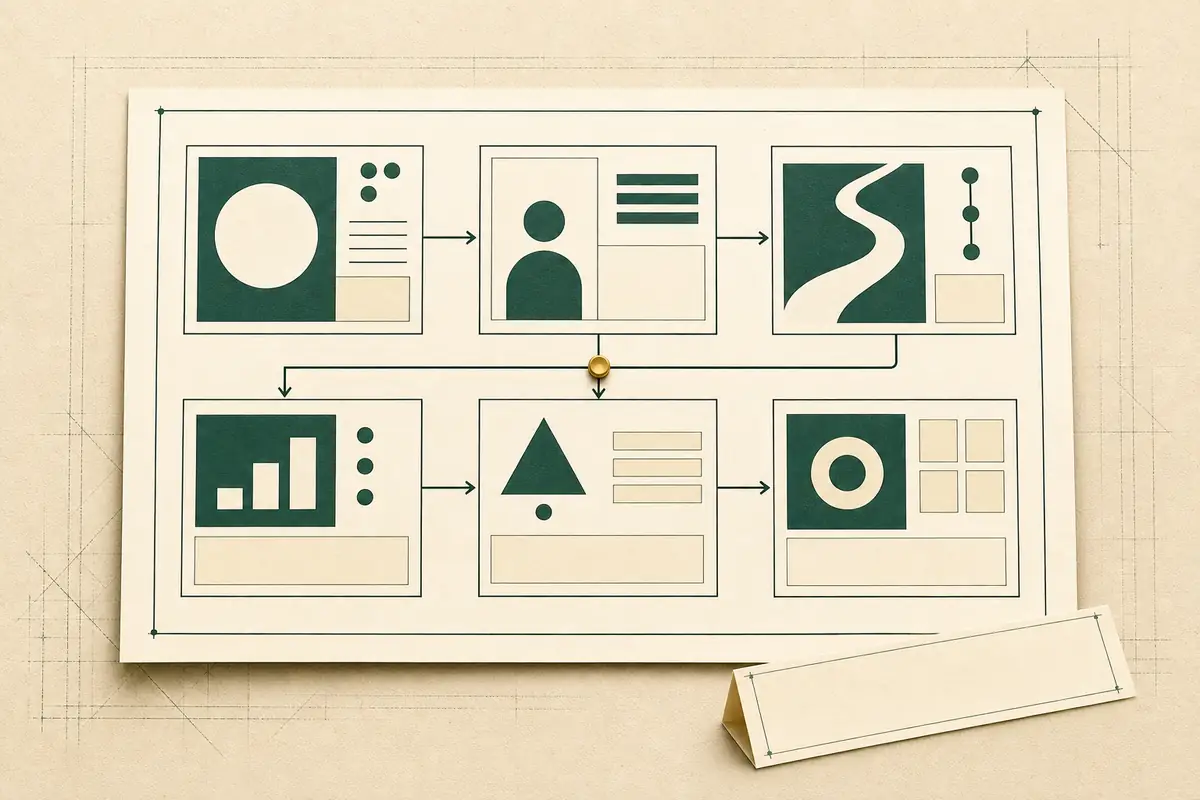
The method proposed here has six blocks: named market, priority buyer, commercial path, supporting evidence, risks and kill criteria, and next test. Every assertion should be labeled as a fact, an assumption, or a result still to be measured. Remove slogans, unsupported market-size figures, generic channel lists, and any roadmap that hides the immediate decision. Before approving a pilot, test the slide with buyers, channel actors, and people who understand local operating constraints. If the evidence cannot change the decision, it does not belong on the slide.
What is a go-to-market slide?
A go-to-market slide is the visible summary of a commercial choice. It tells a reader how a specific offer is expected to reach a specific buyer in a specific market. In pitch-deck resources, OpenVC discusses the go-to-market slide in a pitch-deck context and collects examples, while Pitch describes its template as an action plan for launching a product, reaching target customers, and gaining a competitive advantage (OpenVC; Pitch).
That framing is useful, but a distant-market decision needs a decision-grade slide. Management is not only asking whether the story sounds plausible. It is asking whether the team knows enough to spend money on a controlled market-entry test.
The distinction is simple:
-
A presentation slide explains the intended route to market.
-
A decision-grade slide exposes the evidence behind that route and the conditions that would invalidate it.
-
A pilot slide names the next action that can resolve a decision-critical uncertainty.
This article proposes the following anatomy for that decision. It is a Go International Advisory method, not an external standard. It complements the market-entry framework by forcing the market thesis onto one page.
What is the anatomy of a decision-grade go-to-market strategy slide?
Use one sentence or a small set of bullets in each block. Link to the source material behind the slide instead of shrinking a research report into unreadable footnotes.
| Slide block | What belongs on it | Evidence that can support it | Kill criterion or decision question |
|---|---|---|---|
| Named market | Country or tightly defined region, offer, use case, and the decision being requested | Demand signals, buyer interviews, search or tender evidence, current customer pull, and credible desk research | Is the market specific enough to test, or is the team still comparing countries? |
| Priority buyer | Buying organization, user, economic buyer, trigger, problem, and current alternative | Interview notes, account research, lost-deal notes, distributor feedback, and observed buying processes | Did relevant buyers confirm the problem and a plausible reason to act? |
| Commercial path | Direct sale, partner, distributor, marketplace, or another named route, plus who owns each step | Partner conversations, customer procurement requirements, channel economics, and evidence of access | Can the team reach and serve the buyer without assuming an unproven intermediary? |
| Evidence | The few facts that make the market, buyer, and route credible, with source and date | Primary research, public market data, competitor review, and existing sales evidence | Which central statement is still only an assumption? |
| Risks and kill criteria | Market, channel, delivery, compliance, and economic conditions that could make the entry unattractive | Local expert input, official resources, delivery estimates, buyer objections, and tested commercial terms | What observed result would cause a stop, redesign, or market change? |
| Next test | A scoped real-world action that tests a decision-critical assumption, plus owner and measured outcome | A defined interview, offer test, partner check, paid discovery, or limited pilot proposal | Will the result change the pilot decision? |
The evidence block is not a logo strip. It should connect each statement to something a reviewer can inspect. For market research, the U.S. Small Business Administration prompts teams to examine demand, market size, economic indicators, location, market saturation, and what customers pay for alternatives. Its competitive-analysis guidance also calls for identifying competition by product line or service and market segment, then assessing factors that include barriers and indirect competitors (SBA). Those are useful research questions. They do not remove the need to test your offer with the named buyer.
If the slide exposes uncertainty, that is valuable. Use market research for small business to separate desk evidence from assumptions that require direct contact.
How an international-market slide differs
A domestic go-to-market slide can still be weak, but the team may already understand payment habits, procurement language, service expectations, or the practical role of partners. A distant-market slide cannot silently inherit that familiarity. It must make local dependencies visible.
Add these questions to the slide review:
-
Does the named buyer have the authority and budget path implied by the sales motion?
-
Is the route to market based on direct evidence from a partner or buyer, or on the assumption that the home-market motion transfers?
-
Which local expectation could change the offer, proof required, contracting process, service model, or buying sequence?
-
Which compliance question must be checked by a qualified source before the pilot proceeds?
-
Can the business deliver, support, invoice, and collect under the proposed path?
-
What result would show that localization costs or channel dependence make this route unattractive?
Official resources can provide context without providing your answer. Trade.gov describes its Country Commercial Guides as covering market conditions, opportunities, regulations, and business customs, and describes its data and analysis area as offering data, tools, and reports from trade specialists (Trade.gov). That material can inform a research trail. It does not validate a specific company-market fit, partner, price, or pilot.
This is also why a generic B2B go-to-market strategy needs a market-entry layer when distance changes access, delivery, or risk. The slide should show the dependency, not bury it in an appendix.
What should be removed from the slide?
Space is not the real constraint. Attention is. Remove anything that does not help the reader assess the proposed market, the evidence, or the next commitment.
Cut the following:
-
A long list of channels with no priority, owner, or evidence of access.
-
A total-addressable-market figure that cannot be connected to the named buyer and reachable segment.
-
Personas made from adjectives instead of observed buying roles and triggers.
-
Competitor logos without an explanation of the buyer's current alternative.
-
A global map used to imply reach when the decision concerns one market.
-
A launch calendar that begins before the critical assumptions have been tested.
-
Claims such as “low competition,” “strong demand,” or “easy localization” without a source, date, and scope.
-
Activities such as content, events, outbound, and partnerships when the team has not chosen a primary acquisition path.
-
Metrics that describe activity but cannot confirm or reject the market thesis.
Keep design subordinate to the decision. A template can help organize information, and Pitch explicitly positions its page as a reusable go-to-market strategy template (Pitch). A polished layout cannot resolve a missing buyer, an assumed channel, or a risk with no owner.
What is a copyable one-slide outline?
Paste this into your slide tool and replace every bracketed prompt. Keep the evidence links in speaker notes or a linked evidence register.
GO-TO-MARKET DECISION: [Named market] for [offer / use case]

DECISION REQUESTED
[Fund a pilot / run another test / stop] because [current evidence summary].

MARKET
[Country or region] | [reachable segment] | [trigger or demand signal]
Status: [fact / assumption / untested]
Evidence: [source, date]

BUYER
[Organization type] | [user] | [economic buyer] | [problem] | [current alternative]
Status: [fact / assumption / untested]
Evidence: [source, date]

COMMERCIAL PATH
[Primary route] -> [access point] -> [buying step] -> [delivery and support]
Owner: [name or role]
Evidence: [source, date]

EVIDENCE THAT MATTERS
[Observed fact and source]
[Observed fact and source]
[Contradictory or missing evidence]

RISKS AND KILL CRITERIA
[Risk]: stop or redesign if [observable condition]
[Risk]: stop or redesign if [observable condition]

NEXT TEST
[Action] with [named target group]
Measure: [observable result]
Decision after test: [proceed / revise / stop rule]
Owner: [name or role]
Notice what is absent: vanity metrics, decorative maps, and certainty language. The outline asks for a decision before it asks for a plan. It also makes contradictory evidence visible. A team that only records confirming evidence is building a sales argument, not testing a market thesis.
If your team has a named distant market but cannot complete the buyer, route, evidence, and kill-criteria blocks, Run the Reality Check before committing to a market-entry pilot.
How to test the slide before a pilot
Do not test the slide by asking colleagues whether it looks clear. Test the statements inside it.
Start with an assumption audit. Mark every sentence as observed fact, sourced external information, inference, or untested assumption. Then circle an assumption that would materially change the plan if false. That becomes the next-test candidate.
Use evidence from different positions in the buying system:
-
Ask a relevant buyer to describe the problem, current alternative, trigger, decision roles, and proof expected. Do not lead with your proposed answer.
-
Ask a channel actor to explain access, incentives, account ownership, conflict, enablement, and what would make the offer hard to sell.
-
Ask an operator or qualified local adviser to challenge delivery, contracting, payment, support, and any compliance dependency within their competence.
-
Compare those conversations with desk research on demand, location, alternatives, pricing, barriers, and indirect competition, using the SBA prompts as a research checklist (SBA).
Turn each conversation into an evidence update, not a favorable quote. Record what changed, what remained uncertain, and whether the kill condition moved closer. If different sources disagree, preserve the disagreement on the slide until another test resolves it.
The final review should answer:
-
Is the market decision named precisely?
-
Is the priority buyer based on observed roles and behavior?
-
Is the commercial path available, or merely imaginable?
-
Can a reviewer inspect the evidence behind each central statement?
-
Are the main risks paired with observable stop or redesign conditions?
-
Does the next test resolve a decision-critical assumption?
-
Could an unfavorable result actually stop the pilot?
If the answer to the last question is no, the test is theater. Rewrite the criterion before additional spending.
FAQ
What is a go-to-market strategy slide?
It is a one-page summary of how a specific offer will reach and win a specific buyer in a named market. For a market-entry decision, it should also show the supporting evidence, risks, kill criteria, and next test.
What belongs on a go-to-market slide?
Include the named market, priority buyer, commercial path, decision-relevant evidence, risks with kill criteria, and the next test. Label assumptions clearly and give each test an owner and an observable result.
What evidence supports each block?
Use buyer and partner conversations, account and procurement research, observed sales evidence, credible public data, competitor analysis, official market context, and delivery checks. Match the source to the statement. A country report may support market context, but it cannot prove that your buyer will purchase your offer.
How does an international-market slide differ?
It makes local dependencies explicit. These can include buyer authority, channel access, buying practices, delivery, payment, support, contracting, and compliance questions. Each dependency should be supported, assigned for verification, or converted into a test.
What should be removed?
Remove generic channel lists, unsupported market figures, decorative competitor logos, vague personas, activity calendars, and any metric that cannot change the decision. Keep detail in linked evidence notes when it matters but cannot fit legibly.
How can a team test the slide before a pilot?
Label every statement by evidence status, identify a decision-critical assumption, and test it with people who occupy relevant buyer, channel, and operating positions. Define the result that means proceed, revise, or stop before gathering evidence.
How can the slide earn the pilot?
A good go-to-market strategy slide does not make uncertainty disappear. It shows management which uncertainty remains, what evidence supports the bet, and what the team will do next. For a distant market, that honesty supports the decision. A confident launch story without evidence does not.
Bring a named market, offer, and current evidence. Run the Reality Check to turn the slide into a testable pilot decision.
Written by Tileo, operator at Go International Advisory.