Decision note
Market entry framework: a decision sequence with stop criteria
A market entry framework turns a market thesis into a sequence of decisions, with required evidence and a stop condition at every gate. Start with the thesis, record the entry route as a hypothesis, define what a reversible pilot must establish, and commit only when the named evidence is present. The cited entry-mode taxonomy supplies the route menu. Ghemawat's AAA framework covers adaptation, aggregation, and arbitrage as approaches to global value creation (LibreTexts). Those lenses organize the choice. The gate record supplies the proof before the bet.
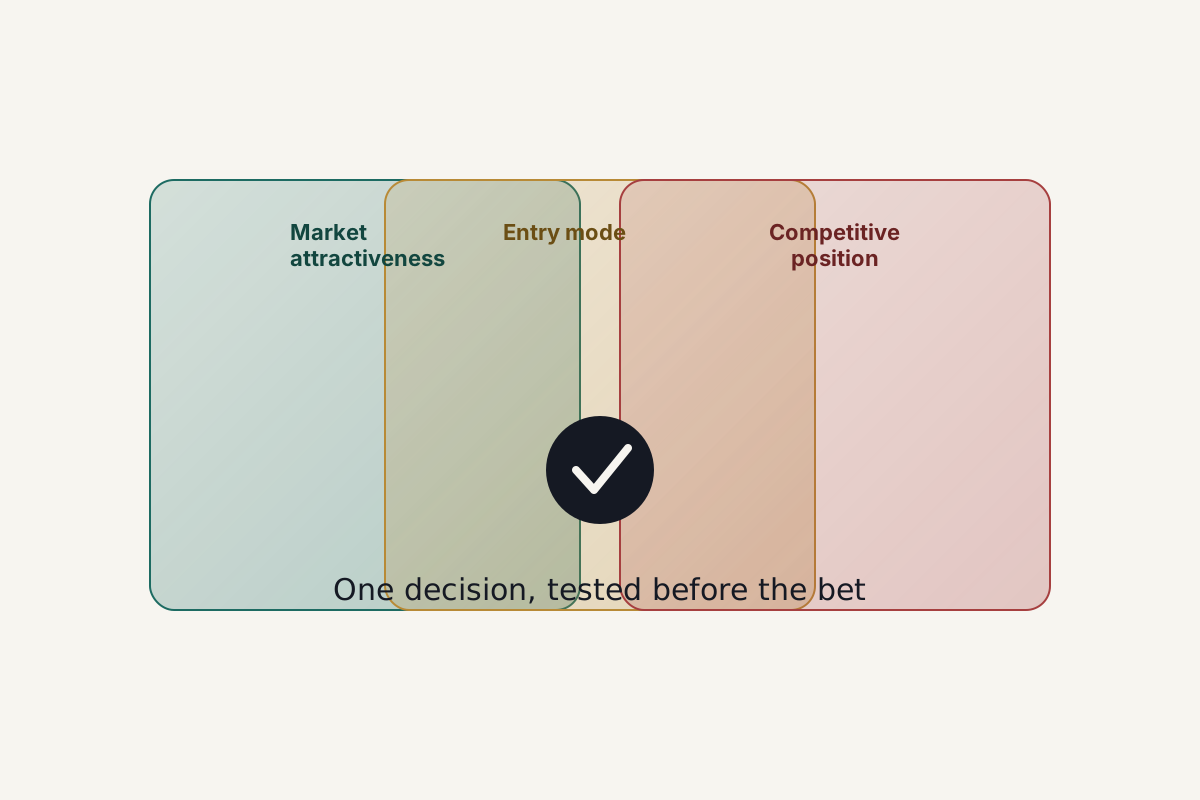
What is a market entry strategy framework?
A market entry strategy framework is a decision record, not a slide sequence. It states the market thesis, the route under consideration, the evidence needed for the next decision, and the action to take if that evidence is missing. That structure separates a choice from the proof required to support it.
The framework can include a strategy lens. Ghemawat's AAA framework offers three approaches to global value creation: adaptation, aggregation, and arbitrage (LibreTexts). LibreTexts describes them this way:
- Adaptation changes part of the business model to suit local requirements or preferences (LibreTexts).
- Aggregation seeks regional or global efficiencies through standardization and the grouping of development and production processes (LibreTexts).
- Arbitrage uses economic or other differences between markets, including by locating parts of the supply chain in different places (LibreTexts).
AAA can name the posture in the strategy record. It does not fill the evidence field. The team still has to write what observation would support the next commitment and what result would stop it. The adjacent market entry strategy guide helps frame the thesis before the evidence gates are set.
What is a market entry model?
A market entry model is the route a firm is considering for operating in the target market. The cited taxonomy covers exporting, licensing, franchising, turnkey projects, wholly owned subsidiaries, joint ventures, and strategic alliances (Wikipedia). It is useful as a menu of routes, not as a decision by itself.
Record the model as a hypothesis. Then write the assumptions that must hold for that route. A partner route and a wholly owned route do not create the same evidence questions. The framework should therefore keep the selected route beside its unresolved assumptions. It should not hide those assumptions inside a final recommendation.
The AAA posture and the entry model belong in separate fields. AAA describes adaptation, aggregation, or arbitrage as approaches to global value creation (LibreTexts). The entry-mode field records the chosen route. One field cannot stand in for the other.
What are the five market entry strategies?
A usable five-strategy shortlist is exporting, licensing, franchising, joint venture, and wholly owned subsidiary. This is a working shortlist, not a universal five-part standard. The cited entry-mode source is broader.
- Exporting: treat exporting as one route in the entry-mode record (Wikipedia).
- Licensing: treat licensing as a separate route, with its own assumptions and evidence field (Wikipedia).
- Franchising: keep franchising distinct from licensing when the decision record compares routes (Wikipedia).
- Joint venture: include the proposed joint-venture route as a named option rather than a generic partner label (Wikipedia).
- Wholly owned subsidiary: record a wholly owned subsidiary as its own route (Wikipedia).
If a route outside the shortlist is a real option for the firm, add it rather than forcing the decision into five rows. The purpose of the list is to expose the actual choice. For a separate route-selection worksheet, use how to choose a market entry strategy.
How does the market entry framework sequence each decision?
The framework moves through thesis, model, pilot, and commitment gates in that order. Each row states the decision, the evidence to record before advancing, and the action to take when that evidence is missing.
| Gate | Named hypothesis or evidence item | Written gate | Stop instruction |
|---|---|---|---|
| Thesis | Buyer-interview evidence for the named market thesis | Advance only when the signed evidence threshold for buyer interviews is met | Stop and revise the thesis when the signed threshold is missed |
| Model | Channel-response evidence for the chosen route | Advance only when channel response meets the signed evidence threshold | Stop and hold the chosen route when the signed threshold is missed |
| Pilot | Pilot acceptance criteria for the named decision | Close the pilot gate only when the recorded result meets the written acceptance criteria | Stop the pilot at its written boundary when the acceptance criteria are not met |
| Commitment | Recorded pilot result for the decision record | Make the next commitment only when the pilot acceptance criteria are recorded as met | Do not make the commitment when the signed threshold is missed |
This sequence preserves uncertainty. “Entry model selected” does not mean “entry approved.” “Pilot planned” does not mean “market proven.” Each statement belongs in a different gate so the decision cannot advance through wording alone.
What evidence closes each gate?
The evidence that closes a gate is the evidence written into that gate before the work begins. This framework does not prescribe an invented universal data threshold. It asks the decision team to name the required evidence, its source, the decision it informs, and the stop criterion tied to it.
Use the following gate record for a named market:
- Thesis gate: write the market thesis and the evidence required to keep it open. If the named evidence is absent, apply the stop criterion.
- Model gate: select the route under consideration from the real options and record its unresolved assumptions.
- Pilot gate: state the narrow decision the reversible pilot must inform. Write its boundary and stop point before activity starts.
- Commitment gate: compare the result with the evidence requirement. Advance only if the named evidence is present. Otherwise stop, hold, or revise as written.
A market feasibility study can sit before the pilot when the open question concerns the market thesis. It should feed the relevant evidence field. It should not silently close a later gate that asks a different question.
How should you write stop criteria and a reversible pilot?
Write the stop criterion as an instruction that can be followed when the result is known. Avoid phrases such as “review the findings” because they leave the decision open. State whether the firm will stop, hold, or revise the route when the named evidence is missing or contradicts the thesis.
The pilot brief should be equally direct:
- Name the decision the pilot must inform.
- Name the evidence that would close the gate.
- Set the boundary that keeps the pilot reversible.
- Write the stop, hold, or revise instruction.
- Record the result against the instruction.
This format keeps the pilot subordinate to the decision. It prevents activity from becoming its own justification. It also leaves a readable record for the next review: the thesis, the route, the expected evidence, the observed result, and the action required by the stop criterion.
Which questions summarize the framework?
What is a market entry strategy framework? It is a decision structure that connects a market thesis, an entry model, evidence gates, a reversible pilot, and written stop criteria.
What is a market entry model? It is the chosen route recorded beside its unresolved assumptions.
What are the five market entry strategies? A working shortlist is exporting, licensing, franchising, joint venture, and wholly owned subsidiary. The source taxonomy is broader, so the shortlist should not be treated as universal (Wikipedia).
What evidence closes each gate? The evidence named in the gate record closes it. If that evidence is absent or contradicts the thesis, the written stop criterion applies.
Turn the framework into a bounded decision. Define the gate, the required evidence, the reversible pilot, and the stop criterion before making the next commitment.
Updated 2026-09-16.
Written by Tileo, operator at Go International Advisory.