Decision note
Market Research for Small Business: A Decision Gate
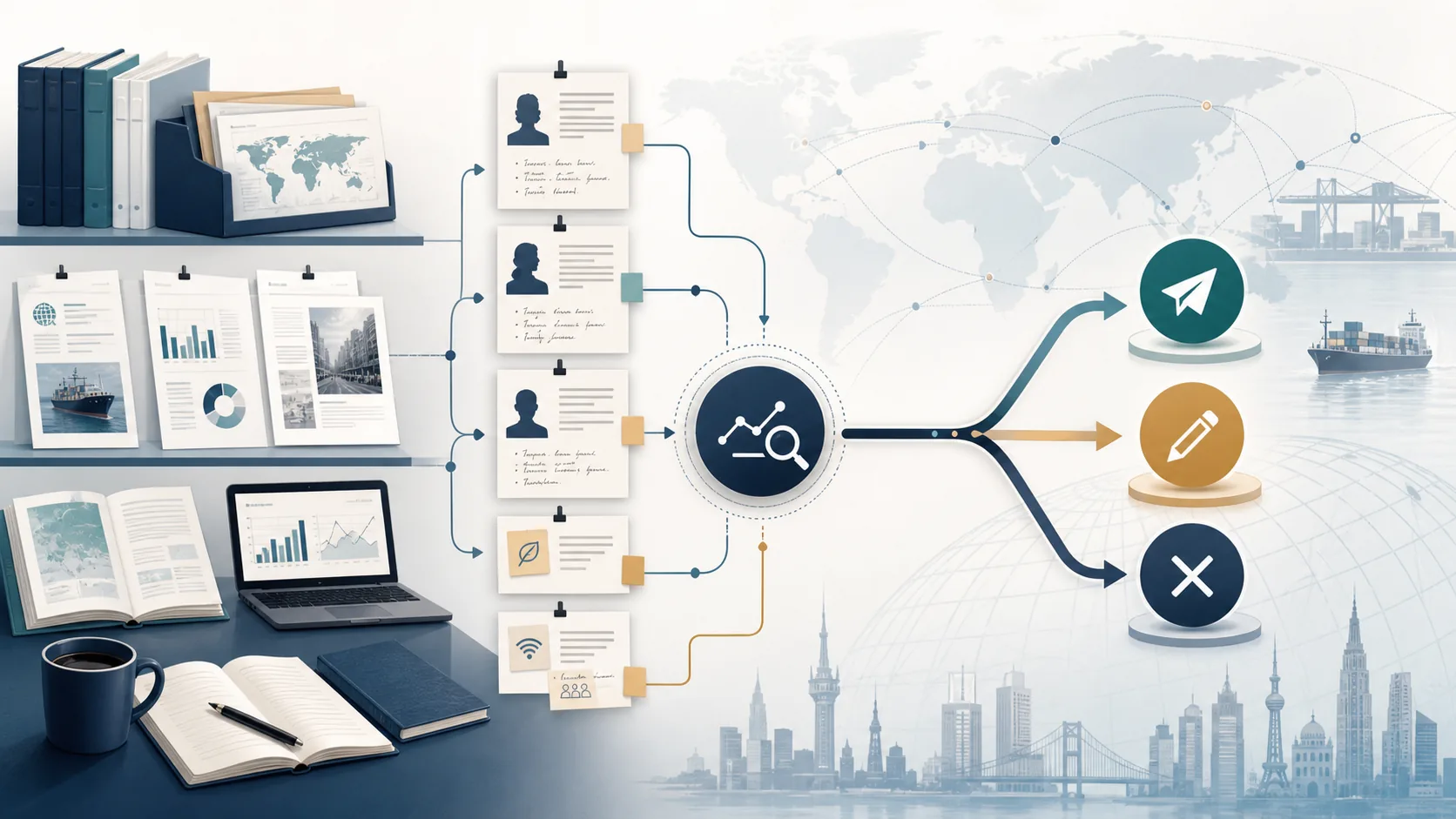
Market research for small business starts with a clear question or test. It ends with steps you can take or a business choice. HBS says to form hypotheses first. It also says to turn findings into conclusions and action items (HBS). BDC says to set a research goal that names the decision to be made (BDC). For a foreign market, Trade.gov puts research before the export plan. It says to use both primary and secondary research to assess markets (Trade.gov). Research cuts doubt. It does not prove demand.
How do you do market research for a small business?
Begin with the question the work must answer. The U.S. Small Business Administration recommends market research to understand customers. It recommends competitive analysis to define a competitive edge (SBA). For an export move, Trade.gov puts market research before export planning. It suggests questions about the market, industry, and distribution channels (Trade.gov).
A source-supported sequence is:
- Set a clear research goal or hypothesis. BDC says the goal should name the decision to be made (BDC). HBS says to form hypotheses before the research starts (HBS).
- Write the research questions. Trade.gov advises developing questions about the foreign market, the industry, and distribution channels before gathering evidence (Trade.gov).
- Review secondary evidence. BDC says to check facts that already exist before doing primary research (BDC). Trade.gov points exporters to country and industry reports (Trade.gov).
- Use primary research for the exact business question. BDC says this work gathers facts for one product or business (BDC). Trade.gov includes direct contact with representatives and possible buyers (Trade.gov).
- Compare the two sets of evidence. Xero says to compare primary findings with secondary research. It also says to seek facts that test your assumptions (Xero).
- Turn findings into action. HBS says the review should lead to conclusions and action items (HBS). BDC ties the research goal to a business decision (BDC).
| Research question | Supported starting method | How to use the result |
|---|---|---|
| What does published evidence say about the country and industry? | Review country and industry reports as secondary research (Trade.gov). | Use the reports as part of an evaluation that combines primary and secondary evidence (Trade.gov). |
| What should we ask about distribution? | Write distribution-channel research questions before export planning (Trade.gov). | Treat the answers as inputs to foreign-market evaluation (Trade.gov). |
| What do relevant people say about the proposed product or business? | Recruit the target demographic for primary research (HBS). | Keep questions neutral so they do not push respondents toward a preferred answer (HBS; Xero). |
| Do primary findings agree with published evidence? | Compare primary results with secondary data (Xero). | Look specifically for findings that challenge the original assumptions (Xero). |
This sequence also leads into a formal market feasibility study. Link the first question to the evidence. Then link the evidence to an action item or choice. HBS and BDC support that path (HBS; BDC).
Which question must be decided before research starts?
Decide what the study needs to learn. Name the business choice it will inform. BDC says to define the research goal and the decision before choosing primary methods (BDC). HBS says to form hypotheses at the start (HBS).
For cross-border work, Trade.gov sets a useful scope. Ask about the foreign market, industry, and distribution channels. Assess the market before you build the export plan (Trade.gov). A working question could be: “What facts do we need about this country, industry, buyer, and channel before we decide?” This is an editorial example. It is not a set template.
Build the brief from source-backed prompts:
- Research objective: identify the business decision the study should inform (BDC).
- Hypothesis: state the proposition the research will examine (HBS).
- Foreign-market questions: cover the country, industry, and distribution channel relevant to the proposed export move (Trade.gov).
- Target respondents: define and recruit the demographic the research is intended to understand (HBS).
- Intended output: specify the business decision or action items the findings should support (BDC; HBS).
New facts may expose a weak assumption. They may also change the first question. Xero says to look for findings that test assumptions (Xero). Note the challenge. Explain how it affects the question or choice. Do not force the facts into a fixed label.
What can desk research answer?
Desk research uses facts that already exist. The Library of Congress Small Business Hub lists many sources. They cover industry trends, rivals, and possible buyers. They also include public data, trade groups, company facts, industry reports, demographic data, and spending data (Library of Congress).
For a foreign market, Trade.gov points to country and industry reports. It treats secondary research as one part of the market review (Trade.gov). Desk research can thus build a base on the named country and industry. It is not the whole review. Trade.gov says to use primary research too (Trade.gov).
Desk research checklist
- [ ] Review relevant country and industry reports identified by Trade.gov as secondary research resources (Trade.gov).
- [ ] Examine industry trends, competitors, and potential consumers using the source categories listed by the Library of Congress (Library of Congress).
- [ ] Develop research questions about the market, industry, and distribution channels before moving into export planning (Trade.gov).
- [ ] Compare the published evidence with later primary findings instead of reviewing either evidence set alone (Xero; Trade.gov).
- [ ] Note results that challenge the assumptions behind the research objective (Xero).
For worked formats, see these market research examples. They show how each question can call for its own type of proof.
When are interviews or field checks needed?
Primary research helps with a question about the exact product or firm. BDC sets it apart from published facts. The data is gathered for that one need (BDC). For an export market, Trade.gov says this can mean direct contact. The contacts may be industry representatives or possible buyers (Trade.gov).
The way you run the talk matters. HBS says to recruit people from the target group. It also says to ask neutral questions (HBS). Xero supports neutral wording too. It warns that a small sample may not reflect the wider customer base (Xero).
Interview checklist
- [ ] Recruit participants from the target demographic the research is meant to understand (HBS).
- [ ] Ask neutral questions that do not signal the preferred response (HBS; Xero).
- [ ] Contact relevant industry representatives or potential buyers when evaluating a foreign market (Trade.gov).
- [ ] Compare interview findings with the secondary research already collected (Xero).
- [ ] Look for responses that challenge the starting hypothesis or assumptions (Xero).
- [ ] Treat conclusions from a small sample cautiously because it may not represent the wider customer base (Xero).
When a foreign-market case needs direct evidence from relevant representatives or potential buyers, Run the Reality Check.
What evidence supports a business decision?
A business choice can draw on primary and secondary evidence. Trade.gov says to use both when you assess foreign markets (Trade.gov). Xero adds one key step. Compare the two sets of findings. Look for facts that test your assumptions (Xero).
The output should link back to the first question. HBS says the last stage draws conclusions and sets clear action items (HBS). BDC says the research goal should name the business decision (BDC). “Decision Gate” is an editorial label for that link. It is not a required three-state system.
Decision evidence checklist
- [ ] The work began with an explicit hypothesis or a research objective tied to a business decision (HBS; BDC).
- [ ] The foreign-market review includes relevant primary and secondary research (Trade.gov).
- [ ] Primary findings have been compared with secondary evidence (Xero).
- [ ] Evidence that challenges the starting assumptions remains visible in the analysis (Xero).
- [ ] Any conclusion drawn from a small sample acknowledges its limited ability to represent the wider customer base (Xero).
- [ ] The analysis ends with conclusions and specific action items or the business decision named in the objective (HBS; BDC).
Use the market entry framework to place the research decision within the wider entry process. For a structured check of buyer access, route, constraints, and economics, continue to the market opportunity analysis guide.
FAQ
What is the first step in small business market research?
Set a research objective tied to the business decision, or form an explicit hypothesis before collecting evidence (BDC; HBS).
What is the difference between primary and secondary research?
Secondary research reviews facts that exist. Primary research gathers facts for the exact product or business (BDC). Trade.gov says to use both to assess foreign markets (Trade.gov).
What should I research before planning an export move?
Trade.gov puts market research before the export plan. It suggests questions about the market, industry, and distribution channels. It points to country and industry reports. It also supports direct contact with representatives and possible buyers (Trade.gov).
How should interview findings be interpreted?
Compare them with secondary research. Look for findings that test assumptions. A small sample may not reflect the wider customer base (Xero).
What should market research produce?
HBS says to draw conclusions and set clear action items (HBS). BDC says the research goal should name the business decision (BDC).
If your foreign-market case still needs direct evidence from relevant representatives or potential buyers, Run the Reality Check.
Written by Tileo, operator at Go International Advisory.