Guide
How to Choose a Market Entry Strategy
Choose a market entry strategy for one named market, customer segment and offer by recording the decisive uncertainty, required control, available evidence, reversibility and stop condition. First collect evidence on buyer needs, competition, barriers, the value proposition and available resources; BDC places goals and market research before the entry-mode decision (BDC). Then compare only credible routes. FAO says foreign-market options vary in cost, risk and control (FAO). If evidence cannot separate the routes, treat a bounded pilot as the next test, not as another universal mode. Choose only the next commitment the evidence supports.
Decision rule: the entry mode follows the evidence for a named market; it does not replace that evidence.
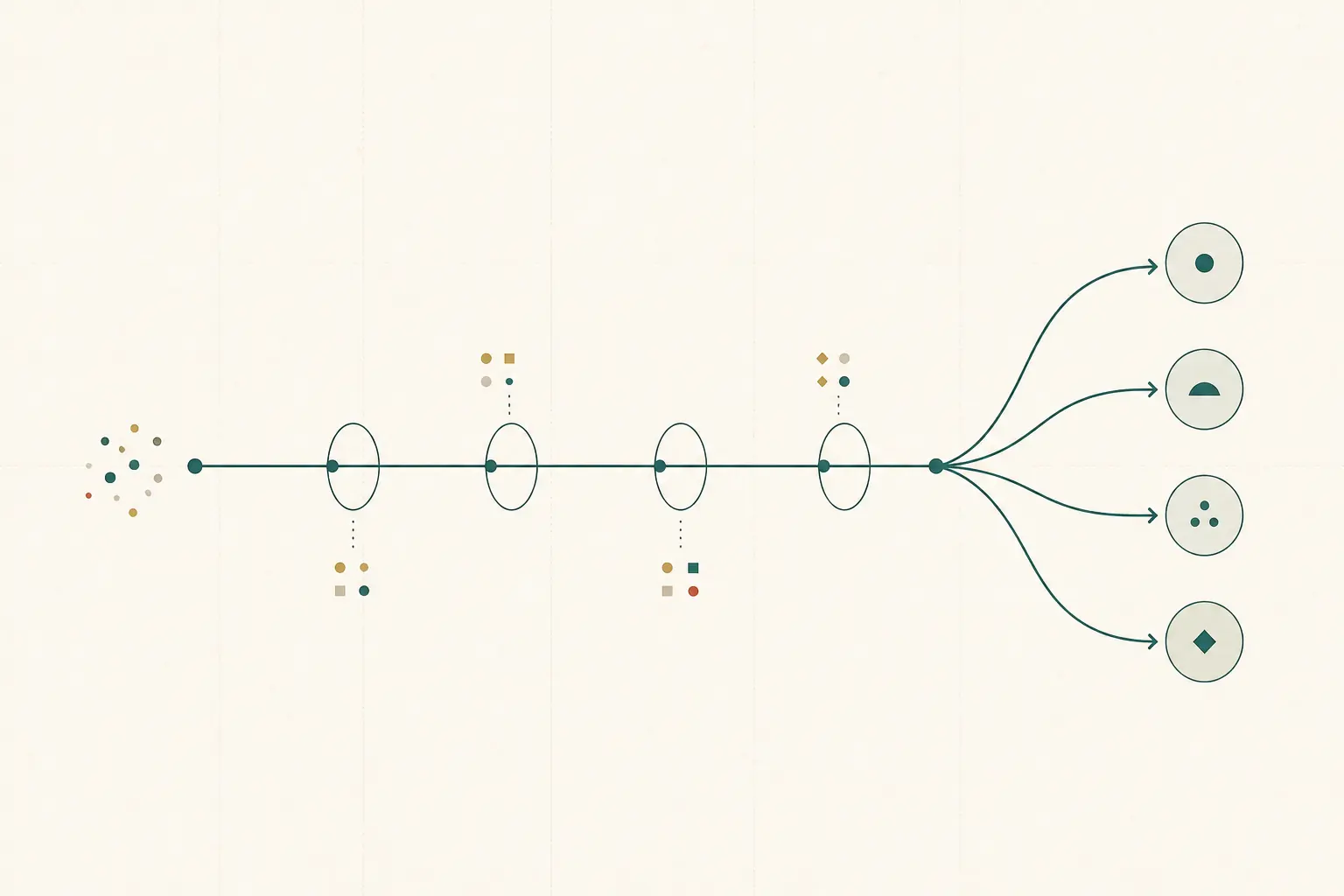
What evidence should you collect before choosing a mode?
Start with a decision unit narrow enough to investigate: one country or defined market, one customer segment and one offer. BDC says market research should cover market size, customer trends and needs, domestic and international competitors, the value proposition, and regulatory, certification, trade and other barriers and opportunities (BDC). Its planning sequence also asks the company to state goals, action items, available resources, a timeline and a budget before it finalises the strategy (BDC).
Turn that research into an evidence gate rather than a descriptive report. The gate should name the decision, the current observation, its source and what that observation changes. The market entry strategy analysis worksheet shows how to keep those inputs attached to the decision.
- Name the commercial decision. State the market, segment, offer and goal. BDC begins its process with clear goals and a defined target market (BDC).
- Record buyer and competitor evidence. Use observations tied to the named segment; BDC specifically includes customer trends and needs and domestic and international competitors in target-market research (BDC).
- Record barriers and internal capacity. Keep the source wording for any regulatory, certification or trade barrier, and state the resources the company can actually assign. Both fields appear in BDC's planning guidance (BDC).
- Define the evidence that changes the route. State what would support, alter or stop the next commitment. This is the editorial evidence-gate method used in this article, not a universal external standard.
A large addressable market does not, by itself, answer whether buyers will engage with this offer or whether the company can support the route. Keep unknowns visible. The purpose of the gate is to prevent an attractive market description from being mistaken for a company-specific entry case.
How should you compare the credible entry routes?
Do not treat one mode list as universal. FAO places exporting, licensing, joint ventures and ownership on a continuum, while BDC separately lists distributors or agents, acquiring a local business, local partnerships, a physical presence, online marketplaces, direct e-commerce and indirect sales through another exporter (FAO; BDC). The useful question is therefore not “How many strategies exist?” but “Which credible route fits this evidence and this company?”
The comparison below is a decision aid, not legal, tax or financial advice. Questions without a source-backed universal answer are deliberately left as questions for the named case.
| Route to examine | What the sources support | Control and exposure question | Evidence and reversibility gate |
|---|---|---|---|
| Exporting | FAO distinguishes direct and indirect exporting and calls exporting the simplest form in its framework; it also notes possible lack of control when decisions sit with agents or distributors (FAO). | Which customer-facing decisions must stay with the company, and which may sit with an agent or distributor? | Can the company use the route to learn about the overseas market before investing in facilities, as FAO describes (FAO)? |
| Partnership or joint venture | BDC lists partnering with a local business as an option. FAO defines a joint venture as an enterprise in which investors share ownership and control over property rights and operation (BDC; FAO). | What would each party contribute, own, decide and observe? | Does evidence support the specific partner and arrangement? FAO says joint-venture partners do not have full management control and that recovering capital may be impossible when needed (FAO). |
| Licensing or franchising | FAO defines licensing as permitting a company in another country to use manufacturing, processing, a trademark, know-how or another skill supplied by the licensor, and says it is similar to franchising (FAO). | Which product, process, trademark or skill is in scope, and what must the company still observe? | FAO describes participation as limited to the agreement's length and subject and says options can remain open for extending participation (FAO). |
| Acquisition or direct investment | BDC lists acquiring an existing local business and establishing a physical presence. FAO calls full ownership the most extensive participation and says it involves the greatest commitment in capital and managerial effort (BDC; FAO). | Which evidence requires ownership or direct control, and how will the commitment affect available resources? | BDC gives no universal reversibility conclusion for an acquisition on the cited page. Record the answer for the named transaction (BDC). |
| Bounded pilot before mode selection | This is the article's editorial test method, not a universal entry mode. It is used only while an observable assumption still separates credible routes. | What is the smallest fair test that preserves the ability to choose again? | Define the decision, evidence boundary and stopping condition before the test; select a mode only after reviewing the observation. |
The table does not score routes or promise that one is cheaper, faster or safer. Those conclusions require evidence for the named market and proposed arrangement. For source-bounded definitions of each operating choice, use the market entry mode guide.
How do uncertainty, control, evidence, reversibility and stop conditions decide the choice?
Keep each decision question separate and reject a universal score. FAO says foreign-market options vary in cost, risk and degree of control, and its descriptions show that control can be shared in a joint venture or extensive under full ownership (FAO). BDC asks companies to calculate how initial production, shipping, hiring and other costs affect working capital, so exposure must be assessed against the company's actual plan (BDC).
- Uncertainty: name the unobserved assumption that still separates credible routes.
- Control and capital exposure: identify the decisions the company must retain and what the proposed route requires. FAO compares modes by control, while BDC connects initial and other costs to working-capital planning (FAO; BDC).
- Evidence: attach every assumption to an observation and source, then state whether it supports, changes or stops the route.
- Reversibility: describe what can be changed if the evidence contradicts the plan. Do not assign a generic label when the sources provide no universal conclusion.
- Stop condition: state what observation would end or redesign the next commitment before that commitment begins.
Compare each credible route against the same evidence file. If one route needs a customer behaviour, partner capability or internal resource that has not been observed, mark that requirement unknown. An unknown is not evidence against the route, but it is not permission to assume the route works.
This is also why conflicting counts in generic strategy lists are not decisive. A source may split direct and indirect exporting, group licensing with other cooperative arrangements, or distinguish acquisition from a new physical presence. The decision still turns on the proposed arrangement's uncertainty, control, evidence, reversibility and stop condition, not on reaching a magic number.
When is a bounded pilot the right next step?
Use a bounded pilot only when a specific, observable unknown prevents a choice between otherwise credible routes. The pilot is not presented here as another universal mode and should not become a vague miniature launch. It is an editorial decision instrument: state the decision it informs, the assumption it tests, the evidence boundary and the stopping condition before work begins.
Suppose exporting and a partner-led route both remain credible. The unresolved issue may be whether the company needs a partner to reach and support the named customer segment. A bounded test can collect evidence on that issue without pretending to settle questions it was not designed to answer. After the review, management may choose one route, redesign the test or stop the commitment.
Do not turn an expression of interest, an introduction or one conversation into a broader claim than the observation supports. Record exactly what happened and what it changes. The useful output is a defensible next decision, not activity presented as validation.
When should the company delay the entry commitment?
Delay the commitment when the market, customer segment, offer or commercial goal remains undefined. BDC puts clear goals and target-market research before mode selection (BDC). Delay it when relevant buyer, competitor, barrier or resource evidence is missing, because those are fields BDC asks the company to investigate or plan (BDC).
Also delay when two routes remain plausible but the team cannot state the observable assumption that separates them, or when no one has defined what would alter or stop the next commitment. These are editorial evidence gates, not claims about a universal duration or success rate. A well-defined “not yet” preserves the ability to investigate; it does not declare the market unsuitable.
What do teams ask about choosing a market entry strategy?
The useful questions distinguish source taxonomies from the choice for a named market.
What are the four market entry strategies?
FAO presents exporting, licensing, joint ventures and ownership as a four-part continuum (FAO). BDC separately lists distributors or agents, acquisition, local partnerships, physical presence, online marketplaces, direct e-commerce and indirect sales through another exporter (BDC).
What are some examples of market entry strategies?
Examples include direct or indirect exporting, licensing or franchising, a partnership or joint venture, acquisition and direct ownership. The source lists differ, so compare only the routes credible for the named market and company (FAO; BDC).
Do you need a defensible next entry decision?
Bring the named market, segment, offer and unresolved commitment. The Reality Check turns those inputs into a go, change, test or stop decision without assigning a universal score or pretending that a generic mode list can choose for you.
Written by Tileo, operator at Go International Advisory.