Comparison
Market penetration vs market development: differences and how to choose
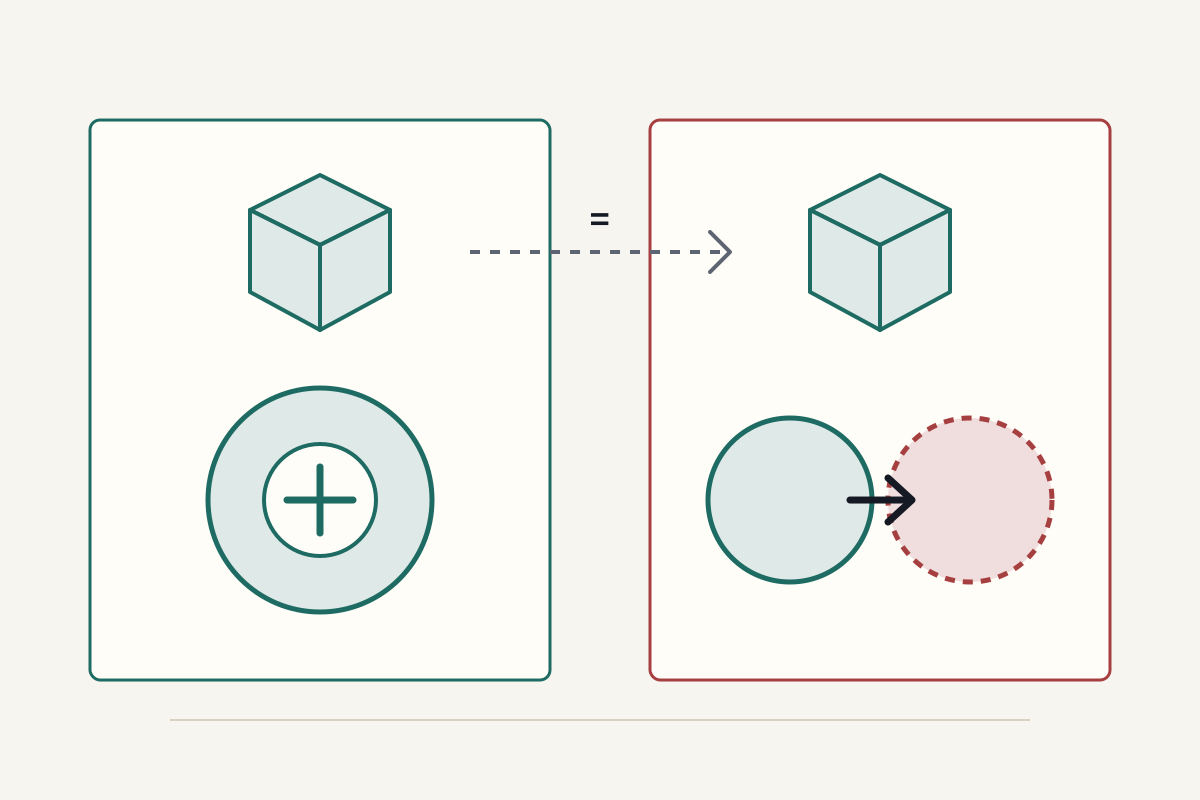
Market penetration sells more existing products in an existing market. Market development sells existing products in a new market. Choose penetration when you want more sales or share in a market you already serve. Choose market development when you keep the product. The target is a new country, region, or customer segment. In the Ansoff matrix, both strategies use an existing product. The choice turns on whether the target market is existing or new (CFI, Ansoff Matrix; GoCardless).
What do you mean by market penetration?
Market penetration is growth from existing products in an existing market. CFI defines it as increasing sales of existing products into an existing market. The market can be a place or a customer segment. Define “existing” before you label the strategy (CFI, Ansoff Matrix).
Credible sources link pricing, promotion and loyalty activity with penetration. These are possible tactics. No company must use them all (Hanover Research; Coursera).
- Choose penetration when the growth question concerns a market the company already serves with its existing product (CFI).
- Frame the decision around increasing sales or share in that existing market (GoCardless).
- Sources link pricing, promotion and loyalty with penetration. Treat them only as possible tactics (Hanover Research; Coursera).
What does market development mean?
Market development is growth from existing products in new markets. The new market can be a place or a customer segment. Taking the current offer to a distant country is therefore market development (CFI, Ansoff Matrix).
GoCardless says market research should find demand for the existing product in the new market. It also says teams should assess consumer behaviour for product fit. Source of Asia adds market validation, localization and channel testing to its account of regional market development. These are the publisher’s stated decision factors, not performance guarantees (GoCardless; Source of Asia).
- Choose market development when the company keeps the existing product. Its target market changes (CFI).
- Treat a new country, region or customer segment as a new-market decision under the matrix (CFI).
- For a distant market, assess demand and product fit. Do not assume that the current-market result will transfer (GoCardless).
- For ASEAN decisions, examine market validation and localization. Also examine channel testing (Source of Asia).
How do market penetration and market development compare?
| Decision dimension | Market penetration | Market development |
|---|---|---|
| Product | Existing product (CFI). | Existing product (CFI). |
| Market | Existing market (CFI). | New geography or customer segment (CFI). |
| Choose when | You want more sales or share in a market already served (GoCardless). | You want to take the existing product into a new country, region, or customer segment (CFI). |
| Growth objective | Increase sales or share in the current market (GoCardless). | Enter the new market with the existing product (GoCardless). |
| Relative Ansoff risk | Least risky of the matrix routes, in relative terms (CFI). | Next least risky. It avoids new-product development but introduces a different market (CFI). |
| Evidence focus | Market potential, customers and competitors in the current market (Hanover Research). | Demand and product fit in the target market (GoCardless). |
| Distant-market framing | Deepen a country already served (CFI). | Validate a named new country for the existing offer (GoCardless). |
How should a mid-market B2B team choose between them?
The Ansoff matrix classifies the direction of growth. It does not prove that a named market is attractive. CFI says the matrix helps management evaluate growth initiatives. It also helps management conceptualize relative risk. Use that classification first. Then make the distant-market decision with evidence specific to the target (CFI).
- Define the existing product and existing market. CFI notes that “market” can mean geography or a customer segment (CFI).
- Name the growth move. More sales in that defined market is penetration. The existing product in a different country or segment is market development (CFI).
- For penetration, assess the current market, customers and competitors. Hanover places those questions in its penetration-strategy process (Hanover Research).
- For market development, test demand and fit in the named target market. GoCardless links the strategy to market research. It also calls for an assessment of consumer behaviour and fit (GoCardless).
- If the target is ASEAN, add channel and localization questions. Source of Asia identifies local partner capability. It also names validation and localization as factors for market development in that region (Source of Asia).
- Choose an entry mode only after naming the market-development decision. Our market entry framework separates market choice from the subsequent route-to-market decision.
- Compare the route choices for the named market. Our market entry strategy guide treats the entry route as a decision that follows market selection.
What's a good example of market penetration?
“Sell the current offer to more industrial buyers in the country we already serve” is market penetration. “Sell that offer to industrial buyers in a country we do not serve” is market development. This classification example follows CFI’s existing and new product-market definitions (CFI).
Can penetration and market development run at the same time?
Yes, when they apply to different defined markets. A company can seek more sales for an existing product in a country it already serves. It can also take that product into a country it does not serve. The first activity remains penetration. The second remains market development. The classification depends on whether each target market is existing or new (CFI).
Source of Asia describes this pattern across ASEAN. A company may be developing access in one country while penetrating another. Treat that as the publisher’s regional account, not as a sequence every B2B company must follow. The useful management step is to label each country-market separately before comparing the evidence and route needed for each one (Source of Asia).
- Label a country already served with the existing product as a penetration market (CFI).
- Label a country not yet served with that product as a market-development target (CFI).
- Do not turn the ASEAN observation into a universal timing rule (Source of Asia).
What if the product changes too?
The other Ansoff routes resolve that classification. Product development introduces new products to an existing market. Diversification enters a new market with new products. CFI calls diversification the highest-risk route in relative terms because both product and market development are involved (CFI).
The matrix compares relative risk. It does not supply a forecast, budget or go-to-market plan. CFI presents it as a framework that helps teams plan and evaluate growth initiatives. GoCardless also notes that companies should consider their risk appetite when using the grid. A distant-market team still has to evaluate the named target and decide how it would enter (CFI; GoCardless).
- Existing product + existing market = market penetration (CFI).
- Existing product + new market = market development (CFI).
- New product + existing market = product development (CFI).
- New product + new market = diversification (CFI).
What are the most common questions about the comparison?
What is the main difference between market penetration and market development?
Market penetration seeks more sales from existing products in an existing market. Market development takes existing products into a new market or customer segment (CFI).
Is a new country market development?
Yes, when the company takes an existing product into that new geographic market. If both the market and product are new, the matrix classifies the move as diversification (CFI).
Can a company use both strategies?
Yes. The Source of Asia comparison describes companies applying market development and penetration across different ASEAN markets at the same time. This is the publisher’s regional observation, not a universal requirement (Source of Asia).
Written by Tileo, operator at Go International Advisory.