International market entry decisions
Market validation vs market size: test the decision
October 4, 2026
Market size estimates how much possible demand exists. Market validation tests whether a named assumption about a buyer, problem, or route holds strongly enough to support the next bounded decision. A large estimate is not validation. A small estimate is not a no-go by itself.
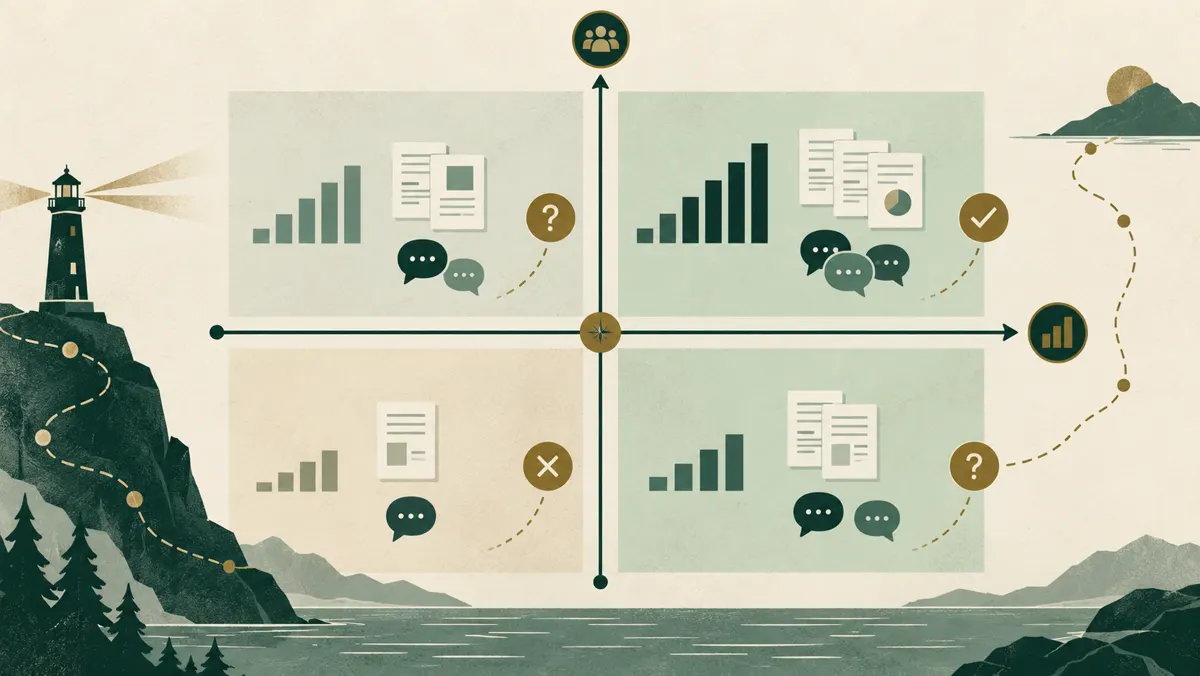
For an international B2B entry decision, keep the scope narrow: one company, one offer, one buyer group, and one country. Use desk evidence to understand the setting. Use live contact with buyers or partners to test the assumption that could change the decision. The U.S. Small Business Administration separates demand, market size, location, saturation, and pricing in its market-research prompts. U.S. Small Business Administration, "Market research and competitive analysis" In GIA's framework, these questions do not form one test.
What is the difference between market validation and market size?
Market size describes the scale of possible demand within a defined boundary. The boundary might specify a country, a buyer group, an offer, and the conditions that make a buyer relevant. The estimate is useful only in relation to that definition.
Market validation examines an assumption. For example: does the named buyer recognize the problem, will that buyer discuss the offer, or can the proposed route reach the buyer? Validation is tied to a decision and to evidence that can support or challenge it.
In GIA's framework, the two work products can disagree without either being defective. A size estimate can be large while live evidence is weak. A size estimate can be small while the evidence for a specific buyer and offer is strong. Neither combination decides entry on its own.
The SBA says market research combines consumer behavior and economic trends to confirm and improve a business idea, find customers, and reduce risk. U.S. Small Business Administration, "Market research and competitive analysis" In GIA's framework, that broad purpose includes distinct questions. It does not turn a count of possible buyers into proof that a particular buyer will act.
Which question does each piece of work answer?
The table below is GIA's commissioning framework, not an industry standard. It separates market-size work from market-validation work.
| Dimension | Market-size work | Market-validation work |
|---|---|---|
| Question | How much possible demand falls inside the stated boundary? | Does the named buyer, problem, or route assumption hold strongly enough for the next decision? |
| Evidence | Published data, category definitions, company lists, and country evidence | Direct contact with relevant buyers or partners, recorded against the stated assumption |
| Output | A bounded estimate with its definition, inclusions, exclusions, and gaps | A finding on the assumption, with the evidence, exceptions, and unresolved points |
| Failure mode | A large figure hides a buyer, offer, or country mismatch | Positive conversations are treated as proof without a stated decision or stop condition |
| Next step | Clarify the boundary or fill a desk-evidence gap | Make the bounded decision, stop, or commission one further test |
In GIA's framework, both assignments begin with a commissioning record. The record names:
- the decision that the work must inform;
- the evidence that can inform that decision;
- the buyer-side owner of the problem or purchase;
- the stop condition for the work;
- the output that the decision-maker needs.
This record prevents a research task from expanding into a general country study. It also exposes a basic mismatch: if the decision depends on a buyer reaction, desk evidence cannot supply that reaction.
What belongs to desk evidence, and what requires live contact?
In GIA's framework, desk evidence describes the market context without claiming that a specific offer has demand. The International Trade Administration says its Country Commercial Guides cover market conditions, opportunities, regulations, and business customs, and that U.S. embassies and trade professionals prepare them. International Trade Administration, "Country Commercial Guides" In GIA's framework, a guide can inform a country brief. It cannot prove that the named buyer will respond to the named offer.
The Montana Department of Commerce says a company should identify and define its target customer or end user before choosing a market-entry strategy. Montana Department of Commerce, "Market Entry" Its market-entry questions ask whether the market has many customers with small orders or fewer customers with large or high-value orders. Montana Department of Commerce, "Market Entry" They also ask whether customers require support. Montana Department of Commerce, "Market Entry" In GIA's framework, these prompts help define the buyer and route.
In GIA's framework, live contact belongs in the assignment when the unresolved question requires a response from a buyer or partner. The SBA lists surveys, questionnaires, focus groups, and in-depth interviews as direct-research methods. U.S. Small Business Administration, "Market research and competitive analysis" In GIA's framework, the method follows the decision and the assumption. The method is not the objective.
In GIA's framework:
- a Market Intelligence Report is the desk-evidence stage when published evidence is missing;
- a live Market Entry Pilot addresses one unresolved question that requires contact with buyers or partners;
- a market opportunity analysis frames the opportunity under a stated boundary;
- a market feasibility study examines whether the proposed entry can work under the company's stated conditions.
How should you read the two-axis decision matrix?
The matrix below is GIA's commissioning framework and opinion, not an industry standard. "Large" and "small" refer to the size estimate relative to the named company's decision. "Strong" and "weak" refer to the validation evidence for the stated assumption. These labels are not universal thresholds.
| Strong live validation | Weak live validation | |
|---|---|---|
| Large size estimate | Preserve the evidence and define the next bounded entry decision. Do not treat scale as proof of route fit. | Do not use the estimate to override the weak signal. Review the assumption, the buyer definition, and the route before commissioning another test. |
| Small size estimate | Check whether the bounded opportunity can support the stated company decision. Do not reject it only because the estimate is small. | Stop or redefine the proposition before adding research. Record which assumption failed or remained unresolved. |
The matrix does not produce a go or no-go verdict. It shows which disagreement needs attention. Scale and validation remain separate evidence streams until a named decision brings them together.
What should a named-country checklist contain?
In GIA's framework, write the country into every line. If a line could be reused unchanged for any country, it is too broad for this decision.
- Name the company, the offer, the buyer group, and the country.
- State the next decision in terms that allow an explicit proceed, stop, or revise outcome.
- Define what the size estimate includes and excludes.
- Record the desk evidence and the gaps that remain.
- Name one buyer, problem, or route assumption that needs live evidence.
- Identify the buyer-side owner of the problem or purchase.
- Set the stop condition before commissioning live contact.
- Specify the output that the decision-maker will receive.
- Keep desk findings separate from statements made by buyers or partners.
- Record the decision that follows, including any unresolved point.
In GIA's framework, the route deserves its own line. The Montana Department of Commerce distinguishes direct entry from entry through a representative or distributor. Montana Department of Commerce, "Market Entry" It also directs exporters to the Country Commercial Guide for the chosen country. Montana Department of Commerce, "Market Entry" In GIA's framework, those prompts help define what to research. They do not validate a particular route for a particular company.
When is the work sufficient for a decision?
In GIA's framework, sufficiency comes from the commissioning record, not from the volume of material collected. The work is sufficient when it addresses the named decision with the specified evidence and reaches the stop condition. An unresolved point can remain, but the output must name it.
Use three checks before accepting the work:
- Does the size estimate use the same buyer, offer, and country boundary as the decision?
- Does each validation finding connect to the stated assumption and to identifiable live evidence?
- Can the decision-maker state what changes because of the finding?
If the answer to one check is no, do not hide the gap in a combined score. Keep the gap visible. Commission only the evidence needed for the next bounded decision.
Frequently asked questions
What does market validation mean?
In GIA's framework, market validation means testing whether a named buyer, problem, or route assumption holds strongly enough to support the next bounded decision. It is not a claim that the whole market has been proved.
What is the difference between market size and market value?
The terms depend on the definition used in the assignment. For this decision framework, market size is an estimate of possible demand inside a stated boundary. If a source uses "market value," record exactly what that source measures before comparing it with another estimate. Do not substitute one undefined label for another.
What types of market analysis matter here?
Separate work by the question it answers. Size work estimates possible demand. Desk research examines the named-country context. Live validation tests one buyer, problem, or route assumption. In GIA's framework, opportunity and feasibility work may use those inputs, but neither label removes the need to state the decision.
What is a useful market-size example for an entry decision?
In GIA's framework, a useful example is a bounded estimate for the named offer, buyer group, and country, with inclusions and exclusions stated. A broad category total that does not match those boundaries is not the same estimate.
How should a team calculate market size?
In GIA's framework, start with the decision boundary, then choose evidence that matches it. State the definition, inclusions, exclusions, and missing evidence. This article does not prescribe a universal formula because the relevant unit depends on the named offer, buyer group, country, and decision.
What is the next bounded step?
In GIA's framework, do not ask whether "the market" is attractive in the abstract. Name the country, offer, buyer, and decision. Then determine whether the open question concerns possible scale or a live assumption.
Written by Loïc Guyon (Tileo), operator at Go International Advisory.