Decision note
Business strategy consulting for international expansion
Business strategy consulting for international expansion should give management a reviewable decision file before it asks for commitment. That file names the target market, buyer, offer and proposed entry route. It separates sourced evidence from assumptions, records what remains unresolved and states what evidence could change the recommendation. It also defines the next bounded test and the rule for proceeding, revising or stopping. Go International Advisory calls this proof before the bet: scope the decision, keep sources and confidence visible, and accept NO-GO as a valid outcome (GIA method). A slide deck can present the work, but the useful product is the evidence behind the decision. The international market entry consulting guide shows what to commission at the evidence, live-pilot and operating-partner gates.
What must the engagement produce?
The engagement must produce evidence that management can trace to a specific expansion decision. The site's method writes the decision, responsibilities and limits before work starts. It also keeps the source, confidence and implication of evidence visible (GIA method).
The practical output is a decision pack, not a broad country portrait. Every part of the pack must answer a management question or expose an unresolved assumption. The following table shows the minimum shape of that pack. It is GIA's operating rubric, not a universal consulting standard.
| Deliverable | Question it answers | What management should see | Decision use |
|---|---|---|---|
| Decision brief | What expansion is under review? | The named market, buyer, offer and proposed route | Keeps the engagement tied to a defined choice |
| Evidence file | What supports or contradicts the case? | Each claim, its source, confidence and implication | Lets reviewers inspect the basis of the recommendation |
| Assumption register | What is still believed rather than shown? | Open questions and the evidence needed to resolve them | Prevents an assumption from appearing as a fact |
| Entry case | How would the company reach and serve the buyer? | The proposed route, operating conditions and unresolved constraints | Connects strategy to execution |
| Test brief | What should happen before a larger commitment? | The bounded question, allowed activity, exclusions and evidence to capture | Defines the next market-facing step |
| Verdict | What can management decide? | Proceed, revise, stop or test, with the evidence attached | Turns analysis into an explicit decision |
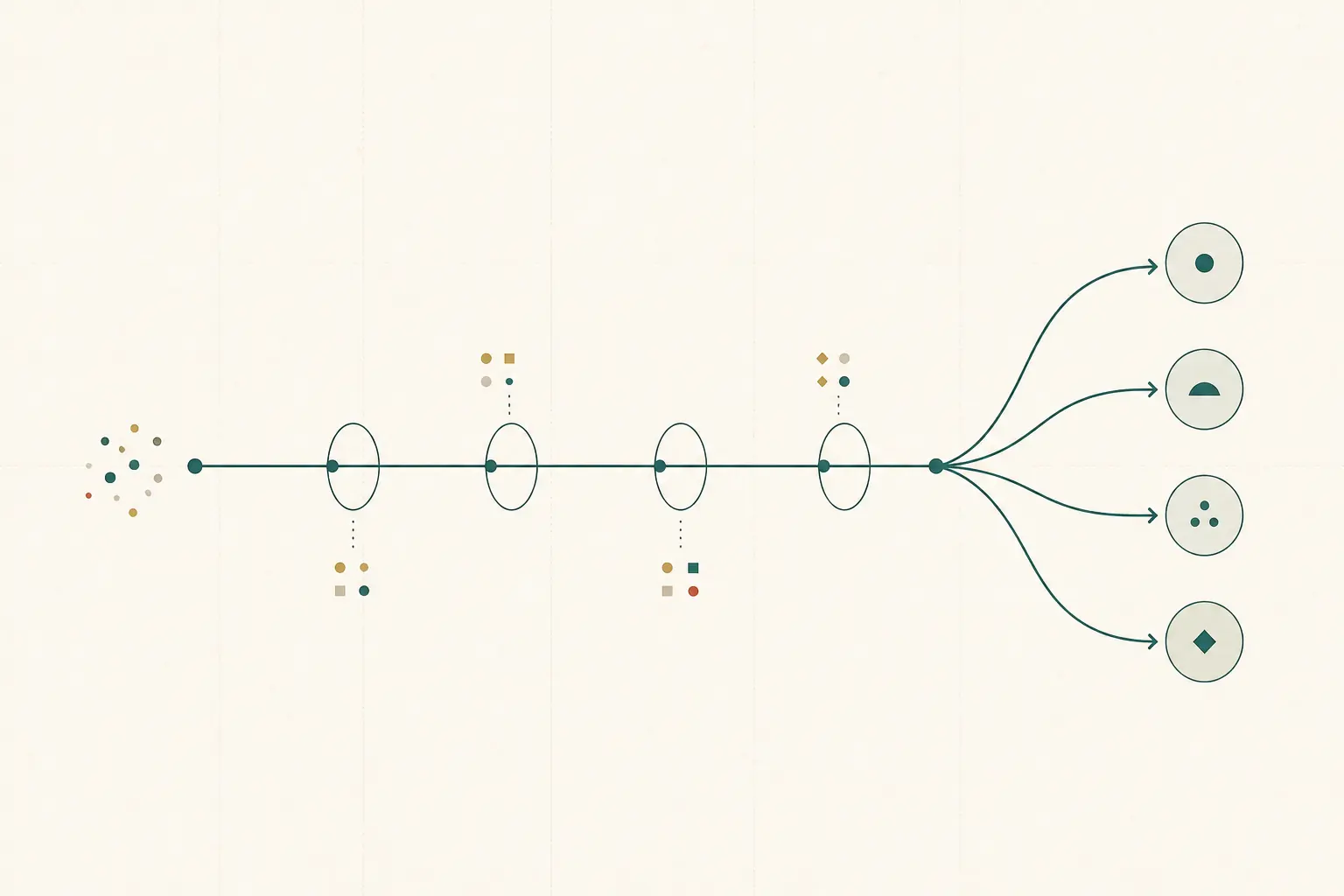
A good pack is easy to challenge. A reviewer can point to a claim, inspect its support and see whether the implication follows. If the recommendation depends on an unstated belief, the file is not ready.
How should the consulting question be scoped?
Scope the work around a named market-entry decision, not the ambition to “expand internationally.” The site’s method starts by writing the decision and its limits (GIA method). That boundary determines which evidence belongs in the work.
The brief should make these elements explicit:
- Target market. Name the country or defined market under review.
- Buyer. State whose response matters to the decision.
- Offer. Describe what the company proposes to present.
- Entry route. Record how the company expects to reach and serve that buyer.
- Decision owner. Name the management role that will act on the evidence.
- Decision boundary. State what this engagement can decide and what remains outside its scope.
This scope keeps the work from becoming a collection of interesting market facts. Evidence earns a place in the file only when it can support, contradict or qualify the proposed entry.
What belongs in the evidence file?
The evidence file should keep claims, sources, confidence and implications together. That structure comes directly from the site's published method (GIA method). It lets management distinguish a sourced observation from a consultant's interpretation. The table below defines the permitted use of each external source.
| Source | Supported claim | Limit | Decision use |
|---|---|---|---|
| ITA Country Commercial Guides | Market conditions, opportunities and regulations | Does not prove that a proposed market entry will work | Frames the conditions and constraints in the entry case |
| World Integrated Trade Solution | Merchandise trade, tariff and non-tariff-measure data | Does not prove that a proposed market entry will work | Tests trade and market-access assumptions against available data |
For each material claim, record:
- the claim in language that can be checked;
- the source or market contact behind it;
- the confidence assigned to the claim;
- the part of the entry case that the claim affects;
- the implication if the claim is wrong;
- the evidence that would confirm, qualify or contradict it.
The file should preserve disconfirming evidence. GIA's method is built to be contradicted and treats NO-GO as a valid outcome (GIA method). A document that contains only support for the preferred route cannot show management where the case may fail.
How do assumptions become testable?
Turn each decision-critical assumption into a question whose answer can change the verdict. The work should not add activity for its own sake. The GIA method removes activity that cannot change the verdict (GIA method).
Begin with the recommendation and work backward. Ask what must be true for that recommendation to hold. Then mark which supporting statements are sourced, which come from market contact and which remain assumptions. The unresolved assumptions become candidates for a Reality Check or a bounded pilot.
A usable assumption statement identifies the part of the entry case at risk and the evidence needed for review. “The market is promising” is not testable. “The proposed buyer will consider the defined offer through the proposed route” is specific enough to frame a market-facing question. This wording is a decision rubric, not a claim about any market.
What should management review before committing?
Management should review the logic of the entry case, the quality of its evidence and the limits of the recommendation. The review is not a vote on presentation quality. It is a challenge to the chain from evidence to action.
Use this review checklist:
- Can the team state the market, buyer, offer and proposed route without changing terms?
- Does every material claim show its source, confidence and implication?
- Are contrary signals preserved rather than explained away?
- Are assumptions labelled as assumptions?
- Does each unresolved question have a defined evidence need?
- Can the proposed next step change the verdict?
- Does the pack state what would lead to proceeding, revising or stopping?
The review should also expose ownership. Someone must own the management decision, and someone must own each unresolved question. A file without owners describes work but does not control it.
When should desk strategy become a market test?
Move from desk strategy to a market test when the remaining uncertainty concerns market response rather than missing desk evidence. In the GIA route, sourced desk evidence frames the decision. A Reality Check or a bounded live pilot then tests whether the unresolved assumptions survive contact with the named market (GIA method; Market Entry Pilot).
The handoff should preserve the decision logic. It should name the assumption under test, the activity allowed, the activity excluded, the evidence to capture and the decision that follows. The pilot is not permission for an open-ended launch. It is a defined way to collect the evidence that the desk cannot supply.
If the work cannot say which result would alter the recommendation, the test brief is incomplete. Return to the assumption register and tighten the question before adding market activity.
What should the final verdict look like?
The final verdict should state what management can decide now and why. It should attach the supporting and contradicting evidence, show the unresolved conditions and preserve the scope of the conclusion.
The verdict can take one of these forms within the site's method:
- Proceed. The evidence supports the defined next commitment.
- Revise. The case remains open, but the offer, buyer, route or test needs a stated change.
- Stop. The evidence does not support the proposed entry under the recorded conditions.
- Test. A decision-critical assumption still requires bounded market evidence.
These labels do not replace the reasoning. The file must show the evidence behind the chosen verdict and the conditions that limit it. That is the difference between advice that sounds decisive and a decision that management can audit.
Frequently asked questions
What should an international expansion strategy consultant deliver?
A decision record, an evidence file, a list of unresolved assumptions, a bounded test plan and a written verdict that management can review. This is GIA's operating rubric, based on its published method (GIA method).
When is an international expansion strategy ready for management review?
It is ready when the target market, buyer, offer, route, evidence, open questions and decision rule are explicit. Readiness here means that the decision can be inspected. It does not predict the market result.
Does desk research prove that a market entry will work?
No. In the GIA method, desk evidence frames the decision, while a Reality Check or bounded pilot tests unresolved assumptions in the named market (GIA method).
Written by Tileo, operator at Go International Advisory.