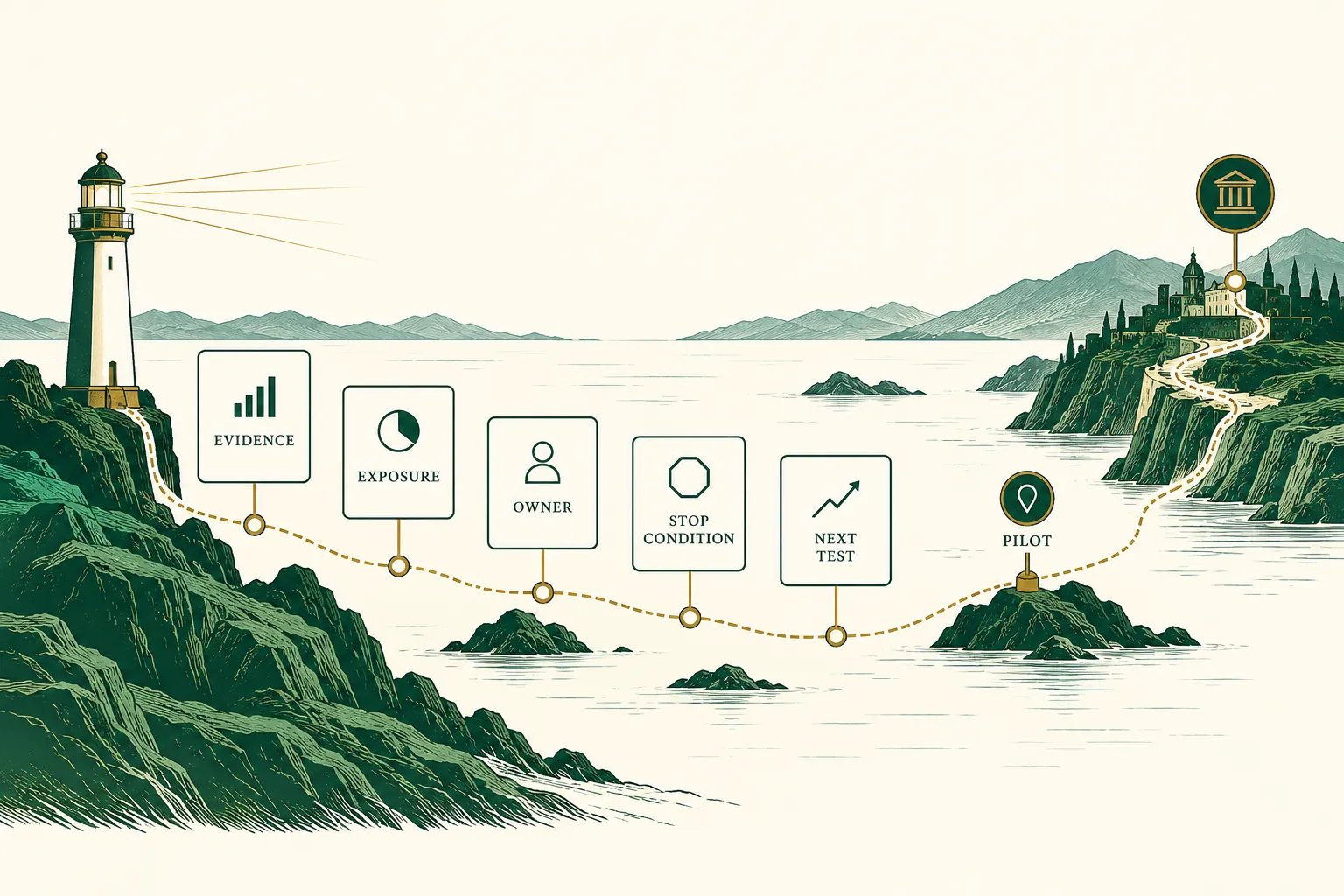
An international expansion risk assessment is a decision record for one named market and one route, not a generic country score. It connects evidence to the exposure created by the proposed entry, assigns an owner, defines a stop condition, and identifies a test to run before commitment. The record also separates what the team knows from what it assumes and what remains unknown. Its purpose is to support a clear decision about a specific expansion. It does not prove that entry will succeed, and it does not replace legal, compliance, financial, or specialist review.
What decision should the assessment answer?
Start with a decision that a named team can make. "Should we expand internationally?" is too broad. A useful question names the market, the route, and the commitment under consideration.
For example: "Should our company enter Spain through a local distribution partner under the proposed operating model?" This wording makes the route part of the assessment. Direct sales, a partner, and a local entity can expose the same company to different dependencies and commitments.
Write the decision header before collecting evidence:
- Named market and customer segment
- Proposed route to market
- Commitment being considered
- Decision owner
- Decision date or review point
- Alternatives that remain open
The assessment can then focus on evidence that might change that decision. It is not a catalogue of every possible international risk.
How is expansion-decision risk different from country risk?
Country risk describes conditions in a market. Expansion-decision risk asks how those conditions interact with a particular route, commitment, and set of dependencies.
The country-risk page inventories external conditions; this page decides whether a specific route and commitment are ready for the next reversible test.
Use GIA's country risk assessment as the detailed country-level input. Do not treat its output as an automatic entry decision. The decision record still has to show how each relevant condition creates exposure for the proposed route, who owns the response, what would stop the plan, and what evidence could resolve an important unknown.
A country condition may matter differently across routes. A dependency on one distributor, for example, belongs in the expansion decision because the proposed route creates that dependency. The assessment should therefore join country evidence to the operating choice instead of repeating a broad country-risk list.
HSBC publishes research and guidance about international business expansion (HSBC, *International Business Expansion Study*). Harvard Business School Online identifies cultural differences as a consideration for international expansion (HBS Online, *Expanding a Business Internationally: 3 Things to Consider*). These sources can inform the evidence file, but the company must connect any relevant point to its named decision.
What belongs in the decision table?
Use one line for each issue that could change the decision or the route. Keep evidence and assumptions separate. A concise table makes gaps visible without turning uncertainty into a score.
| Decision field | What to record | Decision use |
|---|---|---|
| Evidence | A dated source or an observed result that bears on the named decision | Shows what the team can support now |
| Exposure | The consequence for this market, route, commitment, or dependency | Connects the evidence to the proposed entry |
| Owner | The person accountable for checking, responding, or deciding | Prevents an unowned issue from sitting in the record |
| Stop condition | The observable condition that pauses, changes, or ends the proposed route | Defines what evidence would make the team say no or reconsider |
| Next test | The least committed live test that addresses a critical assumption | Produces decision evidence before a larger commitment |
Avoid collapsing the fields into a red, amber, or green label. A label cannot show whether the evidence is current, whether the exposure depends on the route, or whether anyone owns the next decision.
What is the minimum evidence file?
Each material claim in the assessment needs enough context for another decision-maker to inspect it. Record:
- Source. Name the document, interview, observation, or test result.
- Date. State when the evidence was published, collected, or observed.
- Assumption. Write the proposition that the team is relying on.
- Decision owner. Name the person responsible for accepting, rejecting, or rechecking that assumption.
- Confidence or unknown. State the support available and identify what the team does not know.
- Trigger for recheck. Name the event or new evidence that requires another review.
Do not hide an assumption inside a factual sentence. If a prospective partner says that buyers accept the proposed sales process, record the statement as partner evidence and the buyer response as an assumption until it is tested. If sources conflict, preserve the conflict in the file. The decision owner can then decide whether the uncertainty is acceptable, testable, or a stop condition.
How do you turn evidence into stop conditions?
A stop condition states what would cause the team to pause, change, or end the proposed route. It must be observable and tied to the decision. "The market feels unattractive" is not a stop condition. "The pilot cannot validate the required buyer role through the proposed partner route" identifies an observation and the route it affects.
Build each condition in four parts:
- Name the assumption or dependency.
- State the evidence that would contradict it.
- State which decision the contradiction affects.
- Assign the person who can pause or change the plan.
Some evidence may change the route without rejecting the market. Keep that option explicit. The purpose of a stop condition is to prevent commitment from becoming the reason to continue.
How can a live pilot test one critical assumption?
A live pilot should answer one decision question that desk evidence cannot settle. Choose an assumption that matters to the route and can produce observable evidence without committing to the full expansion.
The pilot brief should state:
- The critical assumption under test
- The named market, segment, and route
- The behavior or response to observe
- The evidence that supports, weakens, or leaves the assumption unresolved
- The stop condition and decision owner
- The decision that follows each possible result
A pilot result is evidence about the tested assumption. It is not proof that the whole expansion will succeed. A positive buyer response does not validate every operational dependency. A weak result may challenge the message, the segment, the route, or the assumption itself. Record what the test can distinguish before it starts.
GIA describes its live pilot workflow on the market-entry pilot page. The pilot belongs after the team has framed the decision and identified the assumption that deserves a live test.
What does a hypothetical assessment look like?
Invented teaching example. A fictional mid-market B2B software team is deciding whether to enter Spain through one local distributor. Its record contains a distributor proposal dated October 14, 2026, and buyer-interview notes dated October 16, 2026. These records are invented for the example.
The route depends on the distributor introducing the team to the intended buyer role and presenting the offer without changing its core promise. The observable evidence is whether the proposed introductions reach that role and whether interview participants understand the offer as framed. The exposure is committing staff time and sales enablement to a partner-dependent route before access and message control are demonstrated. The commercial lead owns the decision. The stop condition is evidence that the distributor will not provide access to the intended buyer role or cannot present the agreed positioning.
The next reversible test is a live pilot through that distributor, limited to observing introductions and offer presentation before any larger commitment. If the evidence supports both route dependencies, the commercial lead may proceed to the next reversible commitment; if the evidence is ambiguous, the team pauses and defines another test; if either stop condition is met, it stops this distributor route. Country risk remains an input, while this route evidence determines the conditional proceed, pause, or stop decision without claiming that the expansion will succeed.
How should the team make the final decision?
Bring the evidence file, decision table, pilot result, and unresolved unknowns into one review. The decision owner should choose and record one outcome:
- Proceed with the named route and defined commitment.
- Change the route, scope, or dependency, then reassess the affected assumptions.
- Run another defined test because a critical assumption remains unresolved.
- Stop the proposed entry because a stop condition has been met.
For every outcome, state which evidence drove the decision and what would trigger a recheck. Keep open questions visible. A decision can proceed with uncertainty, but the record should show who accepted it and on what terms.
What should decision-makers ask next?
Is a country score enough to approve an expansion?
No. A country score is an input. The expansion assessment must connect relevant country evidence to the named route, exposure, dependencies, owner, stop condition, and next test.
Should every uncertainty become a pilot?
No. Select a critical assumption that can change the decision and that a live test can observe. Record other unknowns with an owner and a trigger for recheck.
Does a successful pilot validate the expansion?
No. It supplies evidence about the assumption that the pilot tested. It does not prove that the full market entry will succeed or validate dependencies outside the test.
When should the assessment be reopened?
Reopen it when a recorded trigger occurs, new evidence contradicts an assumption, a dependency changes, or the proposed route or commitment changes.
Ready to test the named decision?
Run the Reality Check to frame the market, route, assumptions, stop conditions, and next evidence before commitment.
Written by Loïc Guyon (Tileo), operator at Go International Advisory.