Guide
Market research examples: match the method to the decision still open
Market research examples show how a business question becomes reviewable evidence. Desk research can map a market and expose gaps. Interviews can explain buyer language and rejection reasons. Surveys can compare answers from a defined sample. Concept or behavior tests can show how people respond to an offer or path. For distant-market entry, the useful example is not the most famous brand story. It is the method that answers the unresolved decision and leaves an artifact another person can inspect. GWI distinguishes research types from collection methods and recommends choosing from the question first (GWI).
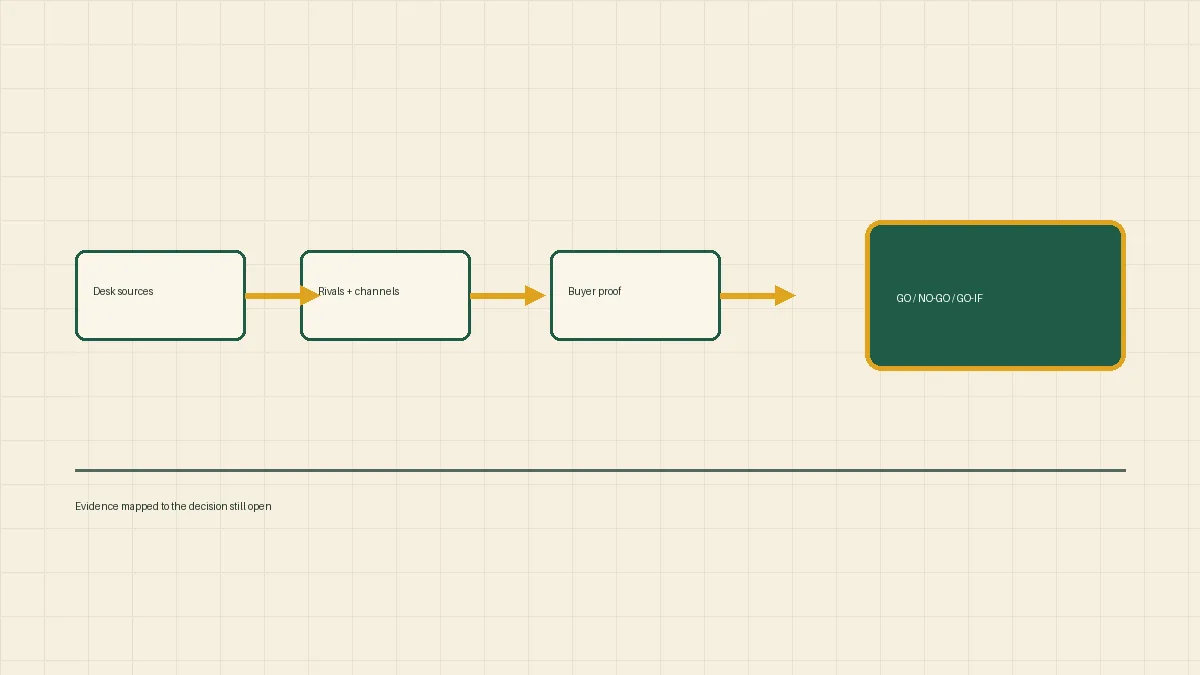
What is an example of market research?
A market research example is a defined question answered with a suitable method and a reviewable evidence artifact. Desk research can produce a dated source register and gap list; interviews can produce attributable notes and themes; surveys can produce a questionnaire, sample definition, and response table; and a concept test can produce a protocol and observed reactions. The useful example is the one matched to the decision still open.
- Question: name the market, offer, buyer, and unresolved decision.
- Method: select primary, secondary, qualitative, quantitative, or a combination because it fits that question.
- Artifact: require sources, notes, responses, or observations that can be reviewed.
- Decision: state what the evidence supports, refutes, or leaves unclear.
When the open question is whether a proposed expansion can proceed in a named market, use a market feasibility study to organize the evidence and decision.
Which market research example fits each entry decision?
The decision comes before the method. GWI separates types of research from the practical methods used to collect answers and warns that the wrong type can waste time and budget (GWI).
| Example | Decision still open | Evidence artifact required | Misuse to avoid |
|---|---|---|---|
| Secondary or desk research | Is the named market worth framing before fieldwork? | Dated source register, assumptions, and unanswered-question list (GWI) | Treating public market data as proof that buyers accept your offer |
| Competitive channel analysis | Which local rivals and acquisition channels merit attention? | Named rivals, observed traffic or channel signals, and source dates (Similarweb) | Copying a channel mix without checking the target market |
| One-to-one interviews | Why might buyers or partners accept, reject, or delay? | Recruitment criteria, interview guide, attributable notes, and themes (GWI) | Presenting qualitative depth as a market-wide count |
| Survey | How do answers vary across a defined sample? | Questionnaire, sample definition, response table, and stated limits (GWI) | Reporting percentages without the sample and question wording |
| Focus group | How does a profiled group discuss a concept or message? | Participant criteria, moderator guide, notes, and competing interpretations (GWI) | Treating group reactions as representative of every buyer |
| Concept or behavior test | What happens when people meet an offer, page, or path? | Hypothesis, protocol, control or comparison where relevant, and observations (MarketingSherpa) | Running an unframed test and calling any movement insight |
Need to separate paper framing from live proof? Run the Reality Check before commissioning another generic pack.
What are real-life market research examples?
Published cases are useful when the method-to-decision link is explicit.
- Airbnb and new-market channels. Similarweb describes Airbnb examining local competitors' traffic sources before entering Israel, then focusing resources on social marketing, display and search ads, and partnerships. The evidence supported a channel decision for that case; it is not a universal entry recipe (Similarweb).
- Wonderbly and a product gap. Similarweb describes Wonderbly using competitor audience and seasonal keyword signals to identify an unaddressed weddings-and-anniversaries category. The transferable lesson is to retain the competitor signal and the resulting decision, not to assume the same category exists in another market (Similarweb).
- A national bank and an A/B test. MarketingSherpa describes a checking-account journey tested against a control. The source also cautions that an A/B test without prior customer and competitor research is random guessing rather than useful market research (MarketingSherpa).
- Hallmark and customer language. MarketingSherpa describes Hallmark's private Idea Exchange community revealing that customers spoke about “stores” while the company used “channels.” The artifact worth copying is attributable buyer language, not the brand name (MarketingSherpa).
What are the 3 types of market research?
There is no single three-type taxonomy in the retained evidence. A practical three-part entry sequence is secondary framing, qualitative exploration, and quantitative or behavioral validation. GWI presents these as overlapping classifications: primary versus secondary describes where data comes from, while qualitative versus quantitative describes the form of evidence (GWI). Do not present the three-part sequence as a universal standard.
- Frame: use existing sources to map the landscape and record gaps.
- Explore: use open qualitative work to discover language, motives, and unexpected constraints.
- Validate: use a defined survey or observed test when the decision needs measurement or behavior.
What are the 7 types of marketing research?
There is no universal seven-type taxonomy in the retained evidence. GWI organizes research by collection mode, data form, and business question, including primary, secondary, qualitative, quantitative, exploratory, consumer, competitive, brand, product, and segmentation research (GWI). Choose the type by the decision, then choose a collection method. A list of seven may mix categories that overlap, so the count itself should not drive the brief.
Can ChatGPT do market research?
The retained evidence does not establish that ChatGPT can replace market research. If AI is used to organize supplied notes or draft questions, humans should still control source selection, sample design, collection, validation, and the final decision. An AI summary is not evidence that buyers, partners, or competitors in a named market behaved as claimed. GWI discusses AI-assisted access to consumer datasets, but that does not validate unsourced model output or remove research-design controls (GWI).
What are the 5 components of market research?
The retained sources do not impose one universal set of five components. For an entry decision, a practical brief can contain five controlled parts: the decision, the source or sample, the instrument, the evidence artifact, and the verdict rule. This is GIA's decision-file structure, not a universal taxonomy.
- Decision: the exact go, no-go, or go-if question.
- Source or sample: who or what can answer it.
- Instrument: source list, interview guide, questionnaire, or test protocol.
- Evidence artifact: the file another reviewer can inspect.
- Verdict rule: what supports, refutes, or leaves the decision unresolved.
What are the 7 basic questions in market research?
Ask: what decision is open; which market and offer are in scope; whose behavior matters; what is already known; what remains uncertain; which method can answer it; and what evidence would support, refute, or leave the decision unresolved. These are planning questions, not a universal research standard. GWI's method guidance likewise starts with the research question (GWI).
What are the 5 Cs of marketing analysis?
The retained sources do not establish one universal 5C formula. A commonly used planning shorthand is company, customers, competitors, collaborators, and context. It can organize a desk review, but it does not select the sample, validate buyer claims, or replace live evidence for a distant-market entry decision. Treat the framework as a set of folders; the source register and field artifacts still have to fill them.
When is desk research enough, and when is live proof required?
Desk research is enough for framing, not for inventing market response. It can map published context, rivals, visible channels, and the questions that remain unanswered. GWI describes secondary research as a foundation and primary research as tailored to a specific firm, segment, product, and market (GWI).
Move to primary or live work when the open decision depends on what named buyers, partners, or users will say or do with your offer. Keep the files separate:
- A Market Intelligence Report frames the paper case.
- A Market Reality Audit pressure-tests the thesis.
- A Market Entry Pilot collects live commercial evidence.
FAQ: market research examples for market entry
What is an example of market research? A market research example is a defined question answered with a suitable method and a reviewable evidence artifact. Desk research can produce a dated source register and gap list; interviews can produce attributable notes and themes; surveys can produce a questionnaire, sample definition, and response table; and a concept test can produce a protocol and observed reactions. The useful example is the one matched to the decision still open.
What are the 7 types of marketing research? There is no universal seven-type taxonomy in the retained evidence. GWI organizes research by collection mode, data form, and business question, including primary, secondary, qualitative, quantitative, exploratory, consumer, competitive, brand, product, and segmentation research. Choose the type by the decision, then choose a collection method.
Can ChatGPT do market research? The retained evidence does not establish that ChatGPT can replace market research. If AI is used to organize supplied notes or draft questions, humans should still control source selection, sample design, collection, validation, and the final decision. An AI summary is not evidence that buyers, partners, or competitors in a named market behaved as claimed.
What are the 5 components of market research? The retained sources do not impose one universal set of five components. For an entry decision, a practical brief can contain five controlled parts: the decision, the source or sample, the instrument, the evidence artifact, and the verdict rule. This is GIA's decision-file structure, not a universal taxonomy.
What are the 7 basic questions in market research? Ask: what decision is open; which market and offer are in scope; whose behavior matters; what is already known; what remains uncertain; which method can answer it; and what evidence would support, refute, or leave the decision unresolved. These are planning questions, not a universal research standard.
What are the 5 Cs of marketing analysis? The retained sources do not establish one universal 5C formula. A commonly used planning shorthand is company, customers, competitors, collaborators, and context. It can organize a desk review, but it does not select the sample, validate buyer claims, or replace live evidence for a distant-market entry decision.
Do not buy a method before naming the decision.
Written by Tileo, operator at Go International Advisory.